
A Powerful Guide to Finding and Fixing the Real Cause
A single inch of rain falling on a 2,000 square foot roof can produce about 1,246 gallons of water. Therefore, even a small blockage can force a large amount of water over one gutter corner during a Miami storm.
AI Overview: Why Gutters Overflow in Heavy Miami Rain
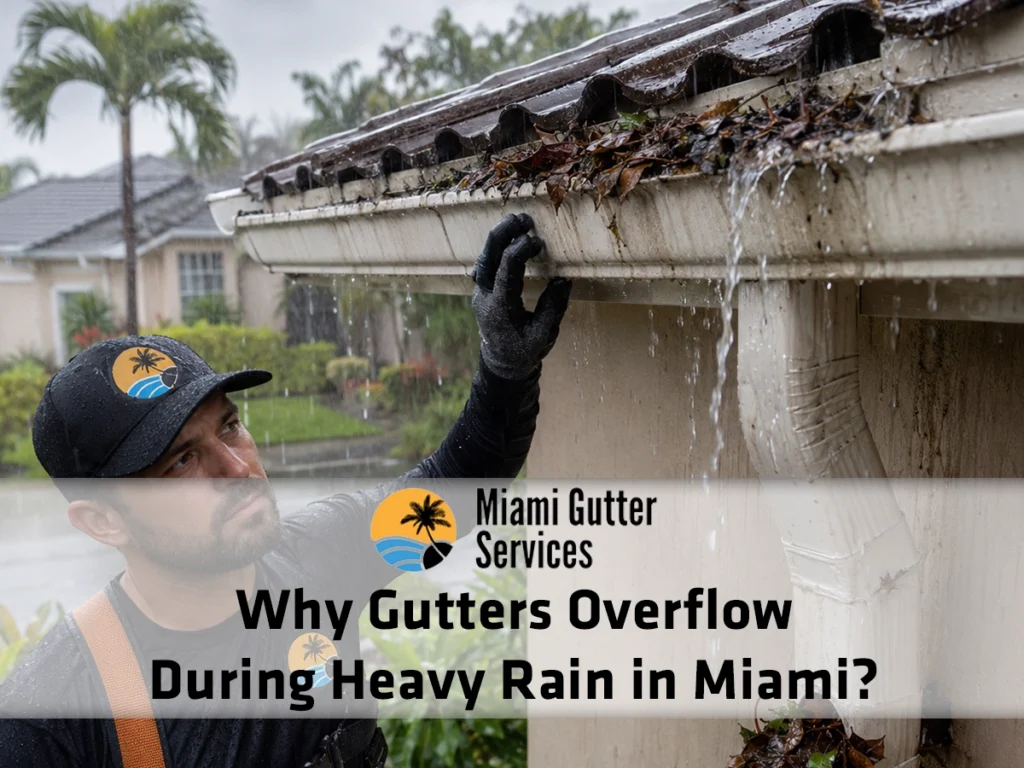
Gutters overflowing during heavy rain in Miami are often caused by a blocked outlet above the downspout. Leaves and small plant debris collect at this narrow opening. As a result, water cannot enter the downspout fast enough.
The backed up water then spills over the gutter near one roof corner. If the issue continues, water may reach the fascia board, stain exterior walls, loosen gutter fasteners, and erode the ground below.
However, debris is not the only possible cause. Gutters may also overflow because of an internal downspout clog, poor gutter slope, sagging sections, damaged guards, or inadequate system capacity.
A professional inspection should identify the cause before repairs begin. The process should include clearing debris, flushing the downspout, testing water flow, checking gutter slope, inspecting fasteners, and looking for gaps behind the gutter.
Properly fitted gutter guards can reduce the number of leaves reaching the outlet. However, guards still require routine inspection and cleaning to maintain reliable water flow.
- A blocked gutter outlet is a common cause of corner overflow
- Fascia damage may develop when overflow continues
- Complete inspection is essential because several problems can occur together
- Gutter guards may reduce repeat clogs caused by nearby trees
1. Why Are Gutters Overflowing During Heavy Rain in Miami?
Gutters overflowing during heavy rain in Miami are warning you that water cannot move through the complete drainage path.
During light rain, a partly blocked system may still drain. However, heavy rain sends water from the entire roof into the gutter within minutes.
If leaves cover the outlet, water begins collecting in the gutter channel. Once the channel reaches capacity, water spills over the nearest edge.
Based on the field experience provided by Miami Gutter Services, hidden downspout blockages are a leading concern. Leaves and small plant debris often gather directly above the outlet.
This small opening connects the horizontal gutter to the vertical downspout. Therefore, it becomes a natural collection point for debris moving with the water.
Other possible causes include poor slope, loose fasteners, sagging sections, damaged guards, and gutters that cannot handle the roof area.
- Overflow near one corner often points toward a blocked outlet
- Overflow across a long section may suggest slope or capacity problems
A professional should inspect the complete system before deciding which repair is necessary.
2. How Much Water Reaches Your Gutters During a Miami Storm?
Roof drainage systems manage far more water than many property owners realize. Even a short downpour can send hundreds of gallons toward several gutter sections.
For example, one inch of rain creates about 0.623 gallons of water for every square foot of roof area. Therefore, a 2,000 square foot roof receives about 1,246 gallons.
Not every gallon reaches one downspout. Roof shape and gutter layout divide the water between drainage points.
However, roof valleys may send a large share toward one short gutter section. A blockage at that outlet can quickly cause overflow.
The National Weather Service provides Miami rainfall records and climate normals for property owners who want to understand local conditions. Its South Florida climate resources show why drainage systems must be prepared for frequent and intense rain.
Review the National Weather Service South Florida climate information for official rainfall records and regional data.
- Larger roof areas create greater runoff volumes
- Roof valleys can concentrate water at one outlet
The amount of water explains why a handful of wet leaves can cause a serious drainage problem.
3. What Is the Most Common Cause of Corner Overflow?
Miami Gutter Services commonly identifies hidden downspout clogs when diagnosing gutter overflow. More specifically, leaves often collect at the outlet above the downspout.
This location is smaller than the gutter channel. Therefore, debris moving along the gutter can gather around the opening.
As more leaves arrive, they form a cover over the outlet. Small pieces may then become packed beneath the larger leaves.
During heavy rain, water presses the debris against the opening. This pressure can make the blockage tighter instead of washing it away.
Customers usually notice water spilling over near one roof corner. Meanwhile, the connected downspout may release little or no water.
The following combination strongly suggests an outlet blockage:
- Water spills over beside one downspout
- Very little water exits from that downspout
Still, the outlet should not be cleared without checking the remaining pipe. Debris may also be trapped inside an elbow or vertical section.
4. Why Do Leaves Keep Blocking the Downspout Outlet?
Nearby trees can repeatedly drop leaves and small plant material onto the roof. Wind and rain then carry that material toward the gutter.
Once debris enters the gutter, flowing water moves it toward the downspout outlet. Therefore, the outlet becomes the final collection point.
A roof may appear clean from the ground while the outlet remains covered. In addition, wet leaves can flatten and form a dense layer.
Miami storms can make this problem worse. Strong wind places fresh debris on the roof, while heavy rain immediately moves it toward the drainage system.
Nearby trees may create repeat clogs even after the outlet has been cleared. For that reason, cleaning alone may provide only a temporary solution.
Property owners should consider:
- How close tree branches are to the roof
- How quickly leaves return after cleaning
Regular inspection can help, especially before the wettest months and after severe weather.
For more preventive guidance, read these overlooked gutter maintenance tips that help prevent damage.
5. How Can You Tell Whether the Outlet Is Blocked?
The first sign is often concentrated overflow. Instead of water spilling along the full gutter, it pours over one corner near a downspout.
The downspout may also produce less water than expected. During strong rain, a clear downspout should carry a visible flow away from the gutter.
You may notice debris gathered around the outlet when viewed from a safe location. However, the opening can be blocked beneath the visible surface.
Other warning signs include dark marks on the fascia, damp areas below the corner, and plants bending under repeated water impact.
Look for these patterns:
- Overflow is strongest beside one downspout
- Water leaving the downspout appears unusually weak
Do not climb onto a wet roof or unstable ladder during a storm. Observe from a safe place and arrange an inspection after conditions improve.
6. Why Does Overflow Damage the Fascia Board?
The fascia is the finished board positioned along the roof edge. In many gutter systems, hangers or fasteners connect the gutter to this area.
When an outlet is blocked, water may spill over the front edge. However, it can also move behind the gutter through gaps.
Repeated exposure may stain the fascia and affect painted or finished surfaces. If the material remains wet, deterioration may develop over time.
Miami Gutter Services uses several checks before connecting fascia damage to gutter overflow. The inspection includes water stains, soft areas, cracks, peeling finishes, and visible gaps.
The team may also test water flow, inspect fasteners, and look for sagging around the affected outlet.
Important signs include:
- Staining directly below the overflow point
- Soft, swollen, cracked, or peeling fascia material
Fixing the fascia without correcting the drainage problem may allow the damage to return. Therefore, the clog or gutter defect must be addressed first.
7. How Does a Professional Confirm the Real Cause?
A complete inspection should follow the path water takes from the roof to the final discharge point.
First, the technician checks the gutter channel and outlet for leaves. Next, the downspout is inspected for restrictions inside its elbows and vertical sections.
Water flow testing can reveal whether the downspout drains freely. If water remains in the gutter, the system may have poor slope or a hidden obstruction.
The inspection should also cover fascia conditions, gaps behind the gutter, loose fasteners, and sagging sections.
Miami Gutter Services considers several findings before recommending a solution. This method matters because gutter overflow often involves more than one defect.
The inspection may include:
- Clearing and flushing the gutter outlet
- Testing the complete downspout for reliable flow
A thorough diagnosis avoids replacing parts that are still working. It also reduces the risk of treating one symptom while missing another cause.
8. What Is the Best Repair for a Blocked Outlet?
The first step is usually clearing the outlet and flushing the connected downspout. However, the complete gutter run should also be cleaned.
Leaves elsewhere in the channel may move toward the outlet during the next storm. Therefore, clearing only the visible blockage can lead to another clog.
The downspout should be tested from the top opening through the final discharge point. Elbows deserve close attention because debris can become trapped inside their curves.
If water has been moving behind the gutter, gaps may need sealing. Loose fasteners may also require tightening or replacement.
When early fascia damage is present, the drainage problem should be corrected before fascia repairs begin.
A complete solution may involve:
- Removing debris from the entire gutter and downspout
- Repairing gaps, loose fasteners, or damaged fascia as needed
Miami Gutter Services provides cleaning and repair services intended to restore functional roof drainage. Its service information describes gutter cleaning as part of maintaining a system that continues protecting the property.
9. Could Gutter Pitch Cause the Same Problem?
Yes. Gutters must have enough slope to move water toward each downspout. If the pitch is incorrect, water may remain in low areas.
Standing water slows the movement of leaves. As a result, debris may settle and become packed inside the gutter.
A section that slopes away from its outlet can overflow even when the downspout is open. Likewise, a sagging gutter creates a low point where water collects.
Pitch problems are difficult to confirm from ground level. Water testing and measurements may be needed to find subtle slope changes.
Possible signs include:
- Water remains in the gutter after rain ends
- Overflow continues after visible debris is removed
Pitch should not be adjusted without checking fasteners and fascia. The support surface must be able to hold the corrected gutter position.
For a broader explanation of likely defects, review the seven most common gutter problems and how to fix them.
10. Can Gutters Be Too Small for Heavy Miami Rain?
Gutter size affects how much water the system can carry. Downspout size also controls how quickly that water can leave.
A system may struggle when a large roof drains into a small gutter section. Roof valleys may increase this demand by concentrating runoff.
However, size should not be blamed before the system is cleaned and tested. A blocked outlet can make a correctly sized gutter appear inadequate.
A professional evaluation should consider roof area, roof slope, valley locations, gutter dimensions, and the number of downspouts.
Capacity may be part of the problem when:
- Clean gutters overflow across several long sections
- Water arrives faster than open downspouts can remove it
The United States Department of Energy Building America Solution Center explains that gutters and downspouts should be designed to collect roof runoff and direct it away from the building.
Read the Building America guide to gutters and downspouts for additional building science guidance.
11. Can Damaged Gutter Guards Cause Overflow?
Gutter guards are designed to reduce the amount of debris entering the gutter. However, damaged or poorly fitted products may restrict water.
Leaves may gather on top of the guard and cover its openings. During heavy rain, water can then travel across the surface and spill over the edge.
Small debris may also enter through gaps. Once inside, it can collect around the outlet where it is difficult to see.
Guards may shift because of weather, installation issues, roof work, or physical damage. Therefore, they need periodic inspection.
Check whether:
- Water enters the gutter instead of flowing across the guard
- Guard sections remain secure around joints and roof valleys
Gutter guards are not a reason to stop maintenance. They are one part of a complete debris control plan.
Learn how to recognize warning signs that a gutter guard is failing.
12. How Do Properly Fitted Gutter Guards Help?
Your selected preventive recommendation is to install properly fitted gutter guards when nearby trees cause repeat clogs.
A suitable guard can reduce the number of leaves reaching the gutter outlet. Consequently, the risk of repeat downspout blockage may decrease.
Fewer blockages can support better water flow during heavy rain. Guards may also reduce how often full cleaning is needed.
However, the result depends on the guard type, installation, roof design, and local debris. No guard can promise that maintenance will never be required.
Property owners should still arrange routine inspections. Small debris, roof grit, seeds, and plant material can enter or collect on the surface.
Expected benefits include:
- Fewer large leaves reaching the downspout outlet
- Lower risk of repeated clogs caused by nearby trees
Proper guards may also reduce repeated overflow around fascia, stucco, and landscaping. Still, existing pitch or capacity problems must be repaired separately.
13. Why Is Cleaning Only the Visible Area Not Enough?
Visible leaves may be only the upper part of the blockage. Debris can remain inside the first elbow or farther down the pipe.
Removing material from the outlet may briefly release water. However, that water can push the remaining debris deeper into the downspout.
The entire gutter run also matters. Leaves left several feet away may travel toward the outlet during the next storm.
Therefore, professional cleaning should address every connected section. It should also include flushing to verify water movement.
A complete service should:
- Remove debris from the full gutter channel
- Confirm that water exits through the downspout
This process helps distinguish a simple clog from poor slope, sagging, undersized drainage, or a damaged connection.
14. What Should You Do While Gutters Are Overflowing?
Stay indoors or observe from a protected ground level location. Do not climb a ladder during heavy rain or strong wind.
Try to identify where the overflow begins. Note whether water spills at one corner, behind the gutter, or across several sections.
Also observe the connected downspout. Weak discharge may support the possibility of a blocked outlet or internal clog.
Take photographs or a short video from a safe position. This evidence may help the service team understand how the system behaves under actual rainfall.
During the storm:
- Keep people away from the concentrated falling water
- Avoid temporary repairs that require roof or ladder access
After the storm, check the ground for erosion and inspect visible fascia surfaces. Prompt service is wise when overflow is severe or fascia damage appears.
15. What Damage Can Repeated Overflow Cause?
Repeated overflow may affect several areas at the same time. The exact damage depends on where the water travels and how long the issue continues.
Fascia damage is a primary concern based on the experience provided for this article. Water may stain, soften, crack, or weaken affected materials.
Overflow may also leave marks on stucco and other exterior finishes. At ground level, concentrated water can move mulch, wash away soil, and harm plants.
Loose gutter fasteners may worsen when water and debris add weight. In turn, the gutter may sag and hold even more water.
Potential consequences include:
- Fascia deterioration and loose gutter supports
- Wall staining, landscape erosion, and standing water
Gutters and downspouts are intended to conduct roof water away from the building. The Building America Solution Center notes that uncontrolled roof runoff can saturate soil around a structure.
16. When Should Gutters Be Repaired or Replaced?
Cleaning is appropriate when debris is the main cause and the gutter remains structurally sound. Repair becomes necessary when the inspection finds leaks, poor slope, loose fasteners, or damaged sections.
Replacement may be considered when defects are widespread. Severe corrosion, repeated separation, extensive sagging, or poor system capacity may make repeated repairs less practical.
Still, replacement should follow an inspection. A single blocked outlet does not automatically mean the entire system has failed.
Miami Gutter Services should consider:
- Whether damage is limited to one repairable section
- Whether the complete gutter system can still drain correctly
Property owners can review these signs that a gutter may need immediate replacement before requesting an assessment.
17. How Can Property Owners Prevent Repeat Overflow?
Prevention begins by addressing the source of debris. Nearby trees should be considered when planning cleaning and guard installation.
Properly fitted guards may help reduce repeated leaf clogs. However, guards should be selected for the actual roof and gutter system.
Routine inspection remains important. A technician should confirm that guards stay secure and that outlets remain clear.
Property owners should also watch the system during rainfall. Early overflow often provides the clearest evidence of a developing restriction.
A practical plan includes:
- Inspecting gutters before Miami’s wettest weather
- Checking guards and outlets after strong wind
Regular maintenance can reveal small problems before concentrated overflow damages fascia or exterior surfaces.
18. A Realistic Miami Overflow Case Pattern
The following scenario is based directly on the experience choices provided for this article. It describes a service pattern rather than a claim about one identified customer.
During heavy rain, a property owner sees water pouring over one roof corner. Meanwhile, little water leaves the nearby downspout.
The inspection finds leaves covering the gutter outlet. Water has also reached the fascia directly below the blocked area.
The technician clears the outlet and removes debris from the full gutter run. Next, the downspout is flushed and tested.
The inspection also checks for gaps, loose fasteners, sagging, and early fascia damage. Repairs are then recommended according to the findings.
Because nearby trees are expected to create another clog, properly fitted gutter guards are discussed as a preventive option.
This case pattern shows two important lessons:
- The visible overflow is a symptom rather than the complete diagnosis
- Preventing another clog may require more than one repair step
19. Frequently Asked Questions About Gutter Overflow
Why do my gutters overflow only during heavy rain?
A partial clog may allow light rain to drain while restricting larger water volumes. During heavy rain, water reaches the gutter faster than it can pass through the blocked outlet. Poor slope, sagging, limited capacity, or damaged guards may also become visible only during strong rainfall.
- Light rain may hide a developing restriction
- Heavy rain tests the full drainage capacity
Why is water spilling over one gutter corner?
Overflow near one corner often suggests that the nearby downspout outlet is blocked. Leaves may cover the opening and prevent water from entering the downspout. However, an internal clog, low spot, poor pitch, or damaged gutter joint may produce a similar pattern.
- Check whether the nearby downspout releases water
- Arrange testing before assuming the exact cause
Can leaves block a downspout even with gutter guards?
Yes. Leaves may enter through gaps or collect on top of damaged guards. Small plant material can also pass through some products. Once debris reaches the outlet, wet material may form a tight blockage that prevents water from entering the downspout.
- Guards reduce debris but do not remove all maintenance
- Poorly fitted sections may allow leaves to enter
Can overflowing gutters damage fascia boards?
Yes. Water may spill behind the gutter and repeatedly wet the fascia. Signs may include stains, peeling finishes, cracks, swelling, or soft areas. The drainage problem should be corrected before damaged fascia is repaired, or the same water exposure may return.
- Look for damage below the overflow point
- Check for gaps and loose fasteners
Will cleaning the gutter fix every overflow problem?
No. Cleaning may solve overflow caused by debris. However, the problem may continue when gutters have poor pitch, sagging sections, undersized outlets, loose fasteners, damaged guards, or inadequate capacity. Water flow testing can help identify whether another repair is needed.
- Cleaning should include the downspout
- Continued overflow requires further diagnosis
Do gutter guards stop all Miami gutter clogs?
No. Properly fitted guards can reduce the number of leaves entering the gutter, but they cannot block every type of debris. Small material and roof grit may still collect. Guards also need inspections after storms to confirm that they remain secure and open.
- Guards can reduce repeat leaf clogs
- Routine care is still required
Should I repair fascia before fixing the gutter?
The gutter and drainage cause should generally be addressed first. Otherwise, overflow may damage the repaired fascia again. A complete inspection can identify blocked outlets, gaps, poor pitch, loose fasteners, and other defects that may be directing water toward the fascia.
- Stop the water source first
- Repair affected materials after drainage works
How can I tell whether a downspout is clogged?
Watch the downspout during rain from a safe location. Weak or absent discharge combined with nearby gutter overflow may indicate a blockage. A professional can flush the pipe and inspect its elbows to locate debris that cannot be seen from the outlet.
- Compare overflow with downspout discharge
- Do not climb during rain to inspect it
21. Conclusion: Stop Overflow Before It Causes More Damage
Gutters overflowing during heavy rain in Miami should not be ignored. The water is showing that part of the drainage system cannot perform correctly.
Based on Miami Gutter Services field experience, leaves covering the outlet above a downspout are a common cause. Water then spills near one roof corner and may begin damaging the fascia.
However, a complete inspection is essential. Downspout clogs, poor pitch, sagging sections, gaps, damaged guards, and system capacity can also affect drainage.
The most effective solution may include clearing the outlet, cleaning the entire gutter run, flushing the downspout, sealing gaps, securing loose sections, and repairing damaged fascia.
When nearby trees cause repeat clogs, properly fitted gutter guards may reduce the amount of leaf debris reaching the outlet. Routine inspection is still needed.
Acting before the next major storm can protect the gutter, fascia, exterior walls, landscaping, and surrounding drainage areas.
- Fix the cause before repairing related water damage
- Use preventive care to reduce repeat overflow
Contact Miami Gutter Services
Contact Miami Gutter Services for professional gutter cleaning, inspection, repair, gutter guards, and downspout solutions in Miami.
Phone: 786 882 4945
Location: 1177 SW 8th St, Miami, FL 33130
Website: www.miamiguttercompany.com