
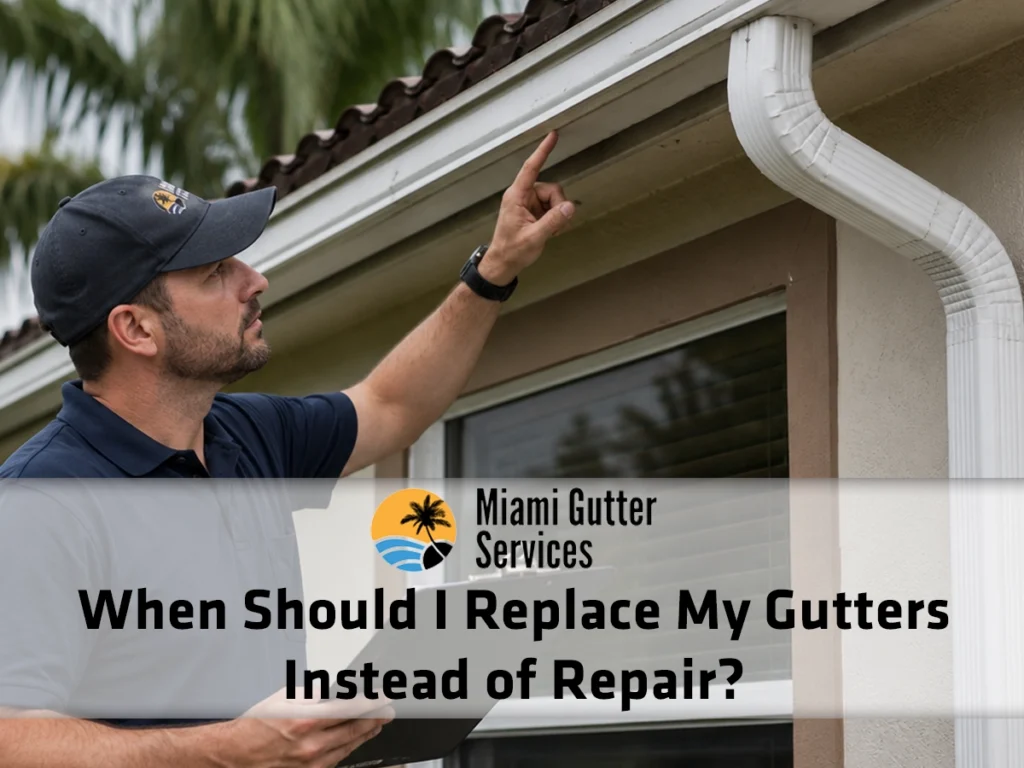
A Powerful Guide to Making the Right Gutter Decision
One inch of rain falling on a 2,000 square foot roof can produce about 1,246 gallons of water. Therefore, worn gutters must manage enormous water loads before another leak, sag, or loose fastener appears.
AI Overview: When Should I Replace My Gutters Instead of Repairing Them?
You should consider replacing your gutters when several parts of the system fail at the same time. Common warning signs include repeated leaks, sagging sections, loose fasteners, weak metal, failing seams, poor slope, and recurring overflow.
A small isolated leak may still be repairable. However, replacement often provides better value when new leaks appear shortly after previous seams were sealed.
Before recommending replacement, a professional should inspect the fascia, gutter slope, seams, corners, end caps, hangers, downspouts, and drainage capacity. This inspection helps separate a limited repair from widespread system failure.
The replacement material should match the roof, budget, design, drainage needs, coastal exposure, humidity, and long term plans. No single gutter material is automatically right for every Miami property.
A well planned replacement should reduce leak points, restore secure attachment, improve water flow, and direct roof runoff away from vulnerable areas.
- Repair may make sense when damage affects one small section
- Replacement may offer better value when several defects appear together
1. When Should I Replace My Gutters Instead of Repairing Them?
When should I replace my gutters instead of repairing them? The answer depends on the number, location, and severity of the problems.
A repair is usually intended to correct a limited defect. For example, a technician may reseal one joint, replace a damaged hanger, or correct a short section.
Replacement becomes more practical when the full system has several connected problems. Repeated leaks, sagging sections, and loose fasteners often indicate wider structural wear.
Based on the field experience provided by Miami Gutter Services, the strongest replacement case involves several warning signs appearing together.
The gutter material may have weakened in several areas. In addition, the fascia may be damaged, the slope may have changed, and older repairs may no longer last.
The system may also have reached the end of its useful service period. However, age alone should never be the only reason for replacement.
- Repair is practical when the problem is isolated and the remaining system is stable
- Replacement is stronger when repeated failures affect several connected sections
Miami Gutter Services offers gutter repair, installation, replacement, cleaning, and related drainage services across South Florida. Its replacement service reflects more than twenty years of stated gutter experience.
2. Why Several Problems Point Toward Full Replacement
One gutter problem does not always require a full replacement. However, several structural problems can show that the system is no longer dependable.
Repeated leaks indicate that water is escaping through joints, seams, corners, or damaged material. Sagging suggests that the gutter shape or support has changed.
Loose fasteners may show that the gutter is moving away from the fascia. Meanwhile, standing water can place more weight on already weak sections.
These failures often affect each other. For example, poor slope leaves water inside the gutter, which places more stress on seams and hangers.
A technician may repair one visible leak. Yet another joint may begin leaking soon because the wider system remains weak.
Replacement deserves serious consideration when you find:
- Repeated leaks across more than one gutter section
- Sagging sections combined with loose hangers or fasteners
The Building America Solution Center explains that gutters and downspouts are important for carrying roof runoff away from building walls and foundation areas. A system that cannot perform this function may leave several parts of the property exposed.
3. When Is a Gutter Repair Still the Better Choice?
Repair can still be the right decision when the damage is small, accessible, and limited to one area.
For example, one leaking end cap may need resealing. Likewise, one loose hanger may be replaced when the surrounding gutter and fascia remain secure.
A short damaged section may also be repairable when the rest of the system has the correct slope and reliable water flow.
The goal should not be to replace a working system without reason. Instead, the inspection should identify whether a focused repair can provide a lasting result.
Repair may be suitable when:
- Only one seam, corner, fastener, or short section has failed
- The gutter still has correct slope, sound material, and clear drainage
A repair should solve the cause rather than hide the symptom. Therefore, the technician should still test water flow and inspect nearby support points.
Property owners can review these common gutter repair mistakes before attempting temporary sealing or support work.
4. Why Returning Leaks Are a Serious Warning Sign
A leak that returns shortly after sealing may show that the original repair did not address the wider problem.
Based on the experience provided for this article, several failing seams or joints are a common cause of returning leaks.
When one seam is sealed, another weak seam may begin leaking during the next storm. Therefore, repeated sealing can become an ongoing expense.
Seams may fail because of movement, standing water, weakened material, poor support, or changes in gutter slope.
Temperature changes can also place stress on connected materials. However, a qualified inspection is needed before assigning one specific cause.
Pay close attention when:
- Leaks appear at several joints instead of one isolated location
- Recently sealed joints begin leaking again during normal rain
A seamless gutter system may reduce the number of joints along long gutter runs. However, corners, outlets, end caps, and downspout connections still require correct installation.
Learn more about the advantages of seamless gutters in Miami.
5. How Sagging Gutters Change the Replacement Decision
Sagging is more than a visual problem. It can change the path that water follows inside the gutter.
Gutters need a controlled slope toward their downspouts. When a section sags, water may collect in the new low point instead.
Standing water adds weight to the gutter and its fasteners. In addition, wet debris may collect in the same area and add more strain.
One sagging area may be repairable when the fascia, material, and nearby hangers remain sound. However, several sagging areas may indicate wider support failure.
Replacement becomes more reasonable when:
- Sagging appears across several sections or returns after adjustment
- Water remains trapped because the original slope cannot be restored
A professional should inspect the fascia before attaching a new gutter system. New gutters cannot remain secure when the support surface is damaged or weak.
6. Why Loose Fasteners Can Signal Wider Failure
Fasteners and hangers hold the gutter against the roofline. When they loosen, the gutter may separate from the fascia.
A single loose hanger can often be replaced. However, repeated movement along a long section may point to damaged fascia or weakened attachment points.
Loose supports may also allow the gutter to twist. Consequently, seams may separate and the drainage slope may change.
Simply driving an old fastener back into a damaged hole may not provide a lasting solution. The surrounding material must be inspected first.
Replacement may be appropriate when:
- Fasteners keep loosening across several parts of the roofline
- The fascia cannot securely support the existing gutter system
The inspection should identify whether the problem is limited to the hardware or involves the fascia and gutter material.
7. What Should Be Inspected Before Replacement?
Miami Gutter Services should inspect the complete drainage system before recommending full replacement.
First, the technician should examine the fascia for stains, softness, cracks, swelling, rot, or previous water damage.
Next, the gutter slope should be reviewed. Water must move toward the correct outlets without remaining in low sections.
Seams, corners, and end caps should also be checked for repeated leaks. Hangers and fasteners must remain firmly connected.
Finally, downspout size, location, and water flow should be evaluated. Replacing the gutter without correcting poor downspout placement may leave the original drainage problem unresolved.
A complete inspection should cover:
- Fascia, slope, seams, corners, end caps, hangers, and attachment points
- Downspout size, outlet location, water flow, and discharge areas
Miami Gutter Company states that roof pitch, overhang, fascia, material, style, and budget should be considered when designing a replacement system.
8. Why Fascia Condition Matters Before New Gutters
The fascia often supports the gutter system. Therefore, its condition affects both repairs and replacement.
Water moving behind the gutter can stain or weaken the fascia. Loose gutters may also pull against damaged attachment points.
Installing new gutters on weak fascia can create another failure. The new system may begin pulling away even when the gutter material is sound.
A contractor should check whether the fascia can hold new hangers and fasteners. Damaged areas may need correction before installation begins.
Important fascia warning signs include:
- Soft, swollen, cracked, stained, or peeling areas
- Fasteners that no longer remain secure in the attachment surface
The gutter and fascia should be treated as connected parts of one water control system. Fixing only one part may leave the other problem active.
9. How Poor Slope Can Make Repairs Temporary
Gutter slope guides water toward the downspout. Even a clean gutter may overflow when water moves in the wrong direction.
Poor slope can develop after hangers loosen, fascia changes, or sections begin sagging. It may also result from an earlier installation problem.
Standing water can stress seams and sealants. As a result, a repaired joint may begin leaking again because water remains against it.
A small slope problem may be corrected by repositioning and securing the gutter. However, widespread distortion may make replacement more practical.
Look for these clues:
- Water remains in several sections after rainfall ends
- New leaks appear where standing water repeatedly collects
Correct slope is one of the main goals of a replacement system. It supports steady movement toward properly placed downspouts.
10. When Do Multiple Failing Seams Justify Replacement?
Traditional sectional gutters contain several joints along their horizontal runs. Each joint is a possible leak location.
One failing seam may be resealed. However, several leaking seams can indicate movement, material weakness, or widespread seal failure.
Based on the experience selected for this article, several seams failing at the same time strongly support replacement.
Continuing to seal each new leak may provide only short term relief. Moreover, the total repair expense may begin approaching replacement value.
Replacement should be discussed when:
- Several seams or joints leak during the same rainfall event
- New leaks appear soon after other seams were repaired
A seamless system can reduce the number of joints along straight gutter runs. Still, professional design and installation remain essential.
Compare seamless gutters and traditional gutters before selecting a replacement style.
11. How Miami Rain Affects Aging Gutter Systems
South Florida weather places frequent demand on roof drainage. Heavy showers can quickly expose weak joints, poor slope, and blocked outlets.
The National Weather Service maintains long term climate records for Miami and other South Florida locations. These records help show why local drainage systems need dependable water control.
A system may appear stable during dry weather. However, one intense storm can reveal leaks across several weak seams.
Wind can also move leaves and plant material onto roofs. That debris may increase weight and restrict drainage during later rainfall.
Miami property owners should pay special attention to:
- Leaks, sagging, or overflow that appears during strong rain
- Damage that returns after storms despite recent repair work
An aging system should be inspected before the wettest weather, especially when previous leaks have already affected fascia or walls.
12. What Should a New Gutter System Achieve?
Replacement should do more than make the roofline look new. The new system must improve how water moves across the property.
Based on your answers, the main expected result is fewer leak points throughout the system.
However, a complete replacement should also restore slope, strengthen attachment, improve capacity, and direct water toward suitable discharge areas.
The system should match the roof size and shape. In addition, downspouts should be placed where they can handle concentrated water flow.
A successful replacement should provide:
- Fewer weak seams and more dependable water movement
- Secure attachment, correct slope, and suitable downspout placement
The United States Environmental Protection Agency explains that runoff flows from rooftops and other hard surfaces. Properly managed downspouts can help direct that water toward a suitable landscaped or drainage area.
13. How to Choose the Right Replacement Material
No single material is right for every Miami property. Miami Gutter Services should consider the complete project before recommending one.
Budget is important, but it should not be the only factor. Roof design, coastal exposure, humidity, maintenance expectations, appearance, and long term ownership plans also matter.
Aluminum is commonly considered because it does not rust like untreated steel. Copper may appeal to owners seeking a distinctive appearance and long service potential.
Vinyl may suit some projects, while steel may be considered where added strength is important. Still, each choice has limitations.
The material decision should consider:
- Roof size, slope, drainage demand, and property design
- Budget, coastal exposure, maintenance, and long term plans
Miami Gutter Company lists aluminum, copper, downspouts, seamless gutters, gutter guards, and rain chains among its installation and repair services.
For a closer comparison, review the most durable gutter materials by weather resistance.
14. Why Seamless Gutters May Reduce Leak Points
Seamless gutters are formed in long runs that fit the measured roofline. Therefore, they can reduce the number of seams across straight sections.
Fewer seams mean fewer joint locations that may need sealing. This feature can be helpful when an old sectional system has several failing joints.
However, seamless does not mean leak proof. Corners, end caps, outlets, and downspout connections still require skilled installation.
The system must also have proper slope and secure hangers. Otherwise, movement may place stress on the remaining connection points.
Seamless replacement may be worth considering when:
- The old system has recurring leaks across several horizontal joints
- The roofline can support long custom formed gutter sections
Material quality, installation, capacity, and drainage design remain as important as the number of seams.
15. When Is One More Repair Likely to Be Temporary?
Another repair may be temporary when leaks return soon after sealing.
This pattern can indicate that several seams are failing. It may also show that movement, standing water, or weak material continues stressing repaired areas.
The repair history matters. One successful repair over many years is different from several service calls within a short period.
Owners should compare the likely repair life with the cost and benefit of replacement. However, exact costs depend on measurements, materials, access, and damage.
One more repair may provide limited value when:
- Leaks return shortly after joints are resealed
- Several other seams show similar wear or movement
The decision should focus on lasting performance rather than the lowest immediate invoice.
16. How Repair History Helps Guide the Decision
A written repair history can reveal patterns that are difficult to see during one inspection.
Record where each leak occurred, which sections sagged, and when fasteners were replaced. Also note whether overflow returned after cleaning.
If each repair affects a different section, the system may be failing in stages. That pattern may support replacement before wider water damage develops.
Property managers should also document photographs and service findings. This record can help decision makers compare repeated repair costs.
Useful records include:
- Dates, locations, findings, repairs, and follow up results
- Photographs of leaks, sagging, fascia damage, and failed seams
Good records support a more objective replacement decision. They also help a contractor design a system that addresses recurring weak points.
17. What Property Areas Can Failing Gutters Affect?
A failing gutter system can affect more than the gutter itself.
Leaks may wet the fascia and leave stains on exterior walls. Overflow may also erode soil, damage landscaping, or create wet areas around walkways.
Downspouts that discharge poorly may direct roof runoff toward vulnerable locations. Therefore, replacement planning should include the final path of the water.
The Building America Solution Center recommends using gutters, downspouts, grading, and other drainage measures to direct water away from a home.
Potentially affected areas include:
- Fascia, soffits, exterior walls, windows, and landscaping
- Soil, walkways, entrances, and lower drainage areas
Replacement cannot correct every site drainage issue. However, it should provide a reliable first step for controlling roof runoff.
18. Should Gutters Be Replaced Before Miami’s Rainy Season?
Replacement is usually easier to plan before repeated storms expose the property to more overflow.
If several leaks and sagging sections already exist, waiting may allow water to reach fascia, walls, or landscaping.
However, the decision should still follow an inspection. A small repair may remain suitable when the rest of the system is sound.
Early planning also gives owners more time to compare materials, gutter profiles, downspout placement, and guard options.
Before the rainy period:
- Arrange an inspection of known leaks, seams, slope, and fasteners
- Complete necessary work before severe weather increases drainage demand
Read these essential gutter replacement tips before Miami’s rainy season for related preparation guidance.
19. A Realistic Gutter Replacement Case Pattern
The following example uses the answers provided for this article. It illustrates a service pattern rather than a claim about a specific customer.
A property has repeated leaks, several sagging sections, and fasteners that continue loosening.
Previous repairs sealed individual leaks. However, new leaks soon appeared at other seams and joints.
During inspection, the technician checks the fascia, slope, corners, end caps, hangers, downspouts, and water flow.
The inspection finds that several connected parts are no longer performing well. Repairing one seam would not correct the weak sections nearby.
Replacement is recommended to reduce leak points and restore a stable drainage path.
The material is then selected according to the roof, budget, property design, coastal exposure, and long term plans.
This case pattern demonstrates two lessons:
- Replacement is based on several related findings rather than one leak
- The new system should correct drainage design and attachment problems
20. A Simple Repair or Replace Checklist
Use this checklist as an early guide. A professional inspection should make the final recommendation.
Consider Repair When
The problem is small and the surrounding system remains sound.
- One seam, end cap, or hanger needs focused attention
- The slope, material, fascia, and downspouts remain functional
Consider Replacement When
Several failures affect connected sections across the system.
- Leaks return after sealing and other seams begin failing
- Sagging, loose fasteners, weak material, or poor slope appear together
Request Immediate Inspection When
Water is reaching building materials or creating unsafe conditions.
- Gutters are pulling away from the fascia
- Overflow is affecting walls, entrances, or surrounding ground
21. Frequently Asked Questions About Gutter Replacement
When should I replace my gutters instead of repairing them?
Replacement is often more practical when several problems appear together. These may include repeated leaks, sagging sections, loose fasteners, failing seams, damaged fascia, and poor slope. A professional should inspect the complete system before deciding whether another repair can provide lasting value.
- Look for patterns across several gutter sections
- Consider replacement when recent repairs keep failing
Can one leaking gutter seam be repaired?
Yes. One isolated seam can often be cleaned, prepared, and resealed when the surrounding gutter remains stable. However, several leaking seams may indicate movement or widespread wear. Water flow and gutter slope should also be checked before assuming the seam is the only problem.
- One isolated joint may support a repair
- Several leaking joints may support replacement
Why do gutter leaks return after sealing?
Leaks may return when nearby seams are also weak, standing water stresses the joint, or loose hangers allow movement. The original seal may have treated the visible opening without correcting slope or support problems. A complete inspection can identify the wider cause.
- Returning leaks may indicate structural movement
- Water should not remain against repaired seams
Are sagging gutters always replaced?
No. One sagging area may be corrected when the gutter, fascia, and hangers remain sound. However, several sagging sections may show widespread support or slope failure. Replacement may provide better value when adjustments cannot restore dependable water flow.
- Limited sagging may be repairable
- Widespread sagging needs full evaluation
Should damaged fascia be repaired before gutter replacement?
Damaged fascia often needs correction before new gutters are installed. The fascia must provide a stable attachment surface for hangers and fasteners. The contractor should also identify why the fascia became damaged so the new system does not direct water toward the same area.
- Confirm that attachment points are secure
- Correct the water source before closing the project
Are seamless gutters better for replacing leaking gutters?
Seamless gutters can reduce the number of joints along straight roof sections. Therefore, they may reduce common leak points. However, corners, outlets, end caps, slope, hangers, and downspouts still require correct design and installation.
- Seamless runs contain fewer horizontal joints
- Professional installation remains essential
What gutter material is best for Miami?
The right material depends on the roof, budget, coastal exposure, humidity, appearance, maintenance needs, and ownership plans. Aluminum, copper, steel, and vinyl offer different benefits. A property inspection should guide the recommendation instead of applying one material to every project.
- Match material to local exposure and design
- Compare initial cost with long term needs
Can cleaning solve leaking and sagging gutters?
Cleaning can remove debris and restore flow when blockage is the main problem. However, cleaning cannot repair weakened seams, damaged fascia, poor slope, loose fasteners, or distorted gutter sections. These conditions may require repair or replacement.
- Cleaning corrects debris restrictions
- Structural defects require additional work
23. Conclusion: Make a Confident Repair or Replace Decision
When should I replace my gutters instead of repairing them? Replacement usually becomes the better choice when several system failures appear together.
Repeated leaks, sagging sections, loose fasteners, weak materials, and several failing seams suggest that another repair may offer only temporary relief.
Still, replacement should never be recommended from one symptom alone. Miami Gutter Services should inspect the fascia, slope, seams, hangers, downspouts, and drainage flow first.
A limited repair may remain appropriate when one isolated section has failed and the surrounding system remains sound.
However, a complete replacement can reduce leak points when the existing system has widespread joint failure.
The new material should match the roof, budget, drainage demand, coastal exposure, appearance, and long term plans.
Most importantly, the replacement system should control roof runoff, protect vulnerable building areas, and perform reliably during Miami rain.
- Repair isolated defects when the wider system remains dependable
- Replace widespread failures when repairs no longer provide lasting results
Contact Miami Gutter Services
Contact Miami Gutter Services for a professional gutter inspection, repair assessment, or complete replacement recommendation.
Phone: 786 882 4945
Location: 1177 SW 8th St, Miami, FL 33130
Website: www.miamiguttercompany.com