
A Powerful 17 Point Guide to Safer Storm Drainage
One inch of rain on 1,000 square feet of roof can produce about 600 gallons of runoff. Therefore, even one blocked outlet or sagging gutter can affect a huge amount of water during a strong Miami storm.
- Heavy roof runoff can expose hidden gutter problems within minutes.
- Early repairs can restore drainage before repeated rain causes wider damage.
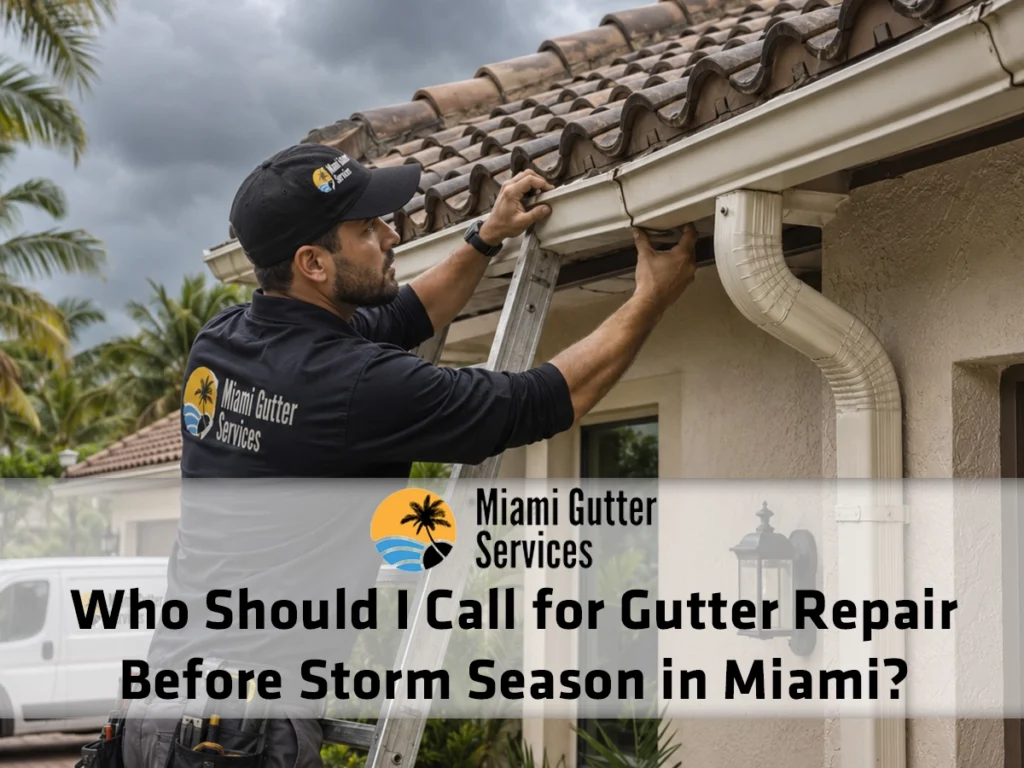
1. AI Overview: Who Should I Call for Gutter Repair Before Storm Season in Miami?
For gutter repair before storm season in Miami, call a local gutter specialist with proven experience in repairs, downspouts, fascia, gutter guards, and complete drainage inspections.
The company should inspect the full system before recommending work. That inspection should cover seams, corners, slope, hangers, fascia, outlets, downspout elbows, guards, roof valleys, and discharge areas.
When several problems are present, repairs should be ranked by safety, active water damage, and drainage impact. Blocked outlets and downspouts often require quick attention. Loose hangers and sagging sections may also need urgent support.
After repairs, the contractor should test every outlet and downspout. Water should move freely without leaking, backing up, or spilling behind the gutter.
Miami Gutter Services states that it offers gutter repair and maintenance, including work involving aluminum, copper, downspouts, seamless gutters, gutter guards, and rain chains. The company also states that it has more than 20 years of experience.
- Choose a specialist who diagnoses the cause before suggesting replacement.
- Require final water flow testing before the repair is considered complete.
2. Why Storm Season Gutter Repair Matters in Miami
The official Atlantic hurricane season runs from June 1 through November 30. However, heavy rain and strong wind can also occur outside those dates.
Storm preparation should begin before severe weather is approaching. Contractors may have fuller schedules once rain increases or a tropical system becomes a concern.
An early inspection gives the company time to identify blocked outlets, poor slope, sagging sections, loose hangers, and leaking joints.
It also gives homeowners time to review the proposed repairs. They can compare the written scope, ask questions, and avoid making rushed decisions.
Even a gutter that appears normal from the ground may contain a clog inside its first downspout elbow. Likewise, a slight slope problem may hold water after every storm.
- Schedule inspection before urgent weather creates service delays.
- Repair active drainage failures before repeated rain adds more stress.
Property owners can use this guide to prepare gutters before hurricane season.
3. Who Should You Call for Miami Gutter Repair?
Call a local company that specializes in gutters rather than a general worker who only offers occasional gutter service.
A gutter specialist should understand how the roof, fascia, gutter channel, outlets, and downspouts work as one drainage system.
The contractor should examine the actual property before providing a final repair recommendation.
Roof size and slope affect water volume. Roof valleys may direct heavy runoff toward one short gutter section.
Fascia strength affects whether hangers can remain secure. Outlet size and downspout placement affect how fast water leaves the gutter.
The company should also understand common Miami conditions, including strong rain, wind carried debris, humidity, nearby trees, and coastal exposure.
Local experience should appear in the inspection process. It should not exist only in advertising language.
- Choose a contractor who explains how each problem affects drainage.
- Avoid companies that recommend work without studying the full system.
4. What Should a Professional Inspection Include?
A professional gutter repair inspection should begin with the horizontal gutter runs.
The technician should check seams, corners, end caps, outlets, and visible leak marks. Sagging areas and low sections should also be documented.
Next, the company should inspect hangers, fasteners, and fascia attachment points.
Soft fascia, loose fasteners, and widening gaps may prevent the gutter from holding the correct position.
The downspout system also requires inspection. A clear gutter channel does not prove that the first elbow or lower pipe is open.
Roof valleys and high flow areas should receive added attention because they may place more water into one section.
Gutter guards should be checked for trapped debris, bent parts, loose edges, and blocked entry points.
- Inspect every part that collects, carries, or releases roof water.
- Connect visible damage with its actual drainage cause.
5. Which Repairs Should Be Completed First?
When several problems appear together, the contractor should prioritize them by risk.
Safety comes first. A gutter that is pulling away or hanging loosely may need support before other work continues.
Active water damage also deserves quick attention. Leaks that reach fascia, stucco, windows, doors, or walls may worsen during repeated rain.
Drainage failures are another priority. A blocked outlet or downspout can stop an entire gutter run from working.
Based on the service priorities selected for this article, clogged outlets and downspouts are often urgent. Loose hangers and sagging gutters may be equally important.
The repair order should be based on the inspection findings. A fixed sequence will not fit every home.
- Address unsafe or unstable sections before they move farther.
- Restore the main drainage path before testing secondary concerns.
6. Why Blocked Outlets and Downspouts Are Urgent
A gutter outlet is the opening that connects the gutter channel to the downspout.
Leaves, palm material, twigs, roof grit, and dirt can gather around this narrow point.
Once the outlet becomes blocked, water begins filling the gutter. During heavy rain, it may spill over the front or move behind the channel.
A blockage may also remain inside the first downspout elbow. Visible debris can be removed from the top while the hidden clog continues restricting flow.
This condition explains why cleaning only the gutter channel may not solve the problem.
The technician should clear the outlet, inspect the elbow, flush the pipe, and confirm that water reaches the final discharge point.
- Weak downspout flow can indicate a hidden internal blockage.
- Overflow beside one corner often points toward a nearby outlet problem.
For more details, review how downspout repair helps prevent water damage.
7. Why Sagging Gutters and Loose Hangers Need Attention
A sagging gutter develops a low section that can hold water after rain ends.
Standing water adds weight to the gutter and its attachment points. Wet leaves and roof debris can add even more pressure.
Loose hangers may allow the gutter to move away from the fascia. As a result, water may escape through the gap or run behind the gutter.
The repair should begin with a fascia inspection. Tightening a hanger into weak material may provide only temporary support.
If the fascia remains sound, the contractor may reposition the gutter, restore the slope, and replace weak hardware.
However, several sagging sections may indicate a wider system problem. Replacement may deserve consideration when repairs cannot restore stable drainage.
- Correct the support problem instead of hiding the visible sag.
- Verify that fascia can securely hold repaired or new fasteners.
8. How Poor Gutter Slope Weakens Water Flow
Gutters need a controlled slope toward their outlets.
If a section slopes in the wrong direction, water may remain trapped even after the downspout is cleared.
Standing water may stress seams, hangers, and end caps. It also creates a place where grit and plant debris can settle.
Based on the answers used for this article, poor slope and a hidden elbow blockage may appear together.
In that situation, the company should remove the clog and adjust the gutter position. Loose hangers may also need to be secured before the slope is corrected.
After adjustment, the technician should test the complete run. Water should travel steadily toward the correct outlet.
- Clearing a clog will not correct a gutter that slopes away from its outlet.
- Slope repair should include support, alignment, and water testing.
9. What Should Happen When Several Problems Appear Together?
Gutter failures often affect one another.
For example, a clogged downspout may leave standing water in the gutter. That added weight may worsen an existing sag.
The sag can then change the gutter slope. As a result, water remains in the channel even after part of the blockage is cleared.
Loose hangers may also create gaps behind the gutter. Water can reach the fascia while the visible overflow occurs elsewhere.
A reliable contractor should not treat each sign as an unrelated problem.
The company should create one repair plan that restores water flow, structural support, slope, and secure attachment.
This approach may include debris removal, flushing, hanger replacement, slope adjustment, sealing, and limited fascia work.
- Connected defects require a coordinated repair plan.
- Treating only one symptom may allow the other problems to continue.
10. How a Reliable Company Decides Between Repair and Replacement
A professional gutter company should consider repair before recommending full replacement.
One blocked outlet, loose hanger, or leaking corner may support focused work when the remaining system is stable.
Replacement becomes more reasonable when repeated leaks, widespread sagging, weakened material, poor slope, and loose attachment points appear across several sections.
The contractor should explain why the proposed repair is likely to last. If replacement is recommended, the estimate should show why repeated repairs may no longer provide good value.
Repair decisions should be based on actual conditions, not sales pressure.
Homeowners should also ask whether fascia repairs or downspout changes are needed. A new gutter will not solve a weak attachment surface or poor discharge plan by itself.
- Repair isolated defects when the wider system remains sound.
- Consider replacement when failures are widespread and recurring.
Review these common gutter problems and possible solutions.
11. What a Written Gutter Repair Estimate Should Include
A written estimate should describe the problem found during inspection.
It should identify the gutter sections, outlets, elbows, hangers, fascia areas, or downspouts included in the work.
The estimate should also explain labor, materials, disposal, testing, payment terms, and warranty details.
If hidden damage may change the price, that condition should be stated before work begins.
For example, fascia damage may not become fully visible until a loose gutter is moved.
The company should explain how added work will be approved. Homeowners should not discover major changes only after receiving the final bill.
Clear estimates help property owners compare contractors fairly. They also reduce confusion about what the repair is expected to accomplish.
- Require a detailed scope instead of a vague repair description.
- Ask how hidden damage and added work will be handled.
12. What Should Happen During the Repair Visit?
The crew should review the approved work before beginning.
Nearby landscaping, windows, walls, walkways, and outdoor items should receive reasonable protection.
The technicians should remove loose debris without pushing it deeper into the drainage system.
When sagging or loose sections are present, the team should determine a safe repair order based on the inspection.
That sequence may involve temporary support, clog removal, downspout flushing, fascia review, hanger repair, and slope correction.
Leaking seams, corners, outlets, or end caps should be prepared correctly before new sealant is applied.
The site should also remain organized. Removed fasteners, sharp metal, leaves, and old sealant should not be left around the property.
- Professional service includes safe work and property protection.
- Each repair step should support the final drainage goal.
13. Why Final Water Flow Testing Is Essential
Your selected service standard places water flow testing at the center of final approval.
After visible debris is removed, the company should run water through every repaired gutter section.
The test should confirm that water moves toward each outlet without collecting in low areas.
Every downspout should also release water with strong, unrestricted flow.
The technician should watch seams, corners, end caps, and outlets during testing. Water should not leak or move behind the gutter.
Testing can also reveal a hidden blockage that remained inside an elbow. Likewise, it may expose a slope problem that was difficult to see earlier.
The Building America Solution Center explains that gutters and downspouts should collect roof runoff and direct it away from building surfaces.
- Appearance alone cannot prove that a repair works.
- Water testing confirms collection, movement, exit, and discharge.
14. Where Should Downspouts Release the Water?
A repaired downspout must do more than empty the gutter.
The discharge point should guide water away from vulnerable walls, doors, walkways, and landscaping.
A downspout that empties beside the home may create pooling even when the gutter above works correctly.
The contractor should observe the ground slope and surrounding drainage conditions.
Extensions or another approved drainage method may be appropriate when water collects near the building.
However, the best discharge solution depends on the property. The contractor should not redirect water toward neighboring land or an unsafe walking area.
The complete repair should manage water from the roof edge to its final release point.
- Confirm where every repaired downspout sends water.
- Avoid discharge areas that cause pooling, erosion, or slippery surfaces.
15. What Warning Signs Mean You Should Call Now?
Do not wait for a named storm when the gutter system already shows active problems.
Water spilling over the edge is one clear sign. Weak downspout flow is another.
Sagging gutters, loose hangers, gaps behind the channel, and standing water also deserve inspection.
Dark fascia stains may show where water has escaped repeatedly. Peeling paint or soft material can indicate a longer term moisture concern.
Other warning signs include leaking corners, separated seams, washed soil, displaced mulch, and puddles near downspout discharge points.
The more warning signs that appear together, the more important a complete inspection becomes.
- Call promptly when water is reaching fascia, walls, or entry areas.
- Arrange service when the gutter moves, sags, leaks, or drains slowly.
Use this guide to determine whether your gutter system is ready for summer storms.
16. What Homeowners Should Avoid Before Storm Season
Avoid climbing onto a wet roof or using a ladder during rain or strong wind.
The safest choice is to observe the gutter from ground level and document where overflow occurs.
Do not force rigid tools into a downspout without knowing the pipe layout. That attempt may damage an elbow or push debris deeper.
Avoid sealing a leaking seam while standing water remains in the gutter.
Likewise, do not keep tightening loose fasteners without checking the fascia behind them.
Temporary work may hide the symptom while the main drainage failure continues.
Professional inspection is especially important for tall homes, steep roofs, damaged gutters, and hard to reach downspouts.
- Do not trade a gutter problem for a serious fall risk.
- Avoid repairs that ignore hidden clogs, slope, and fascia strength.
Homeowners should also review these common gutter repair mistakes.
17. A Representative Miami Storm Repair Example
The following example is based on the service priorities selected for this article. It is not presented as a verified customer case.
A homeowner notices heavy overflow near one corner during rain. Very little water exits the connected downspout.
The gutter also sags near that outlet. Several hangers appear loose along the same roof section.
During inspection, the technician finds debris at the outlet and a hidden clog inside the first elbow.
The trapped water has added weight to an area that already had weak attachment points.
The company chooses a safe repair order based on the actual conditions. It clears the blockage, checks the fascia, secures the gutter, corrects the slope, and flushes the downspout.
Final testing confirms that water reaches the outlet and exits freely.
- The visible overflow had more than one connected cause.
- The repair restored both drainage flow and structural support.
18. Frequently Asked Questions About Storm Season Gutter Repair
Who should I call for gutter repair before storm season in Miami?
Call a local gutter specialist with experience in cleaning, repairs, fascia concerns, downspouts, gutter guards, and full system inspections. The company should inspect the property before recommending work. It should also explain repair options, provide a written estimate, and test water flow before completing the project.
- Look for local drainage knowledge and clear communication.
- Require inspection, documentation, repair options, and testing.
How early should I schedule gutter repair before storm season?
Schedule inspection before severe weather is approaching and before the contractor calendar becomes crowded. The Atlantic hurricane season officially starts June 1, although heavy rain can occur at other times. Early scheduling provides time for inspection, written estimates, repairs, testing, and any required follow up work.
- Plan before an active storm becomes a concern.
- Allow time for hidden damage or added repair needs.
What gutter problem should be repaired first?
The first repair depends on safety, active damage, and drainage impact. Loose or unstable gutters may need immediate support. Blocked outlets and downspouts may also require urgent service because they stop water from leaving. A complete inspection should determine the correct repair order for the property.
- Address unsafe movement and active water damage first.
- Restore blocked drainage paths as soon as practical.
Why is my downspout still slow after cleaning?
A hidden blockage may remain inside the first elbow or another pipe section. Poor gutter slope may also slow water before it reaches the outlet. A professional should flush the full downspout, inspect bends, test the gutter slope, and check whether the outlet is large enough for the runoff.
- Visible cleaning may not reach an internal clog.
- Slow flow can involve both blockage and alignment.
Can sagging gutters be repaired before storm season?
A limited sag may be repairable when the gutter material and fascia remain sound. The company may replace hangers, restore alignment, and correct the slope. However, several sagging areas or weak fascia may require more extensive work. Water flow testing should follow every adjustment.
- The fascia must support repaired attachment points.
- Repaired sections should drain without holding water.
How do I know the repair is complete?
The contractor should test every repaired gutter run, outlet, and downspout. Water should move freely without standing in low areas. Seams and corners should remain dry, and the gutter should not spill water behind the fascia. Final testing should also confirm that downspout discharge reaches a suitable area.
- Require water testing instead of relying on appearance.
- Review the results during a final walkthrough.
20. Conclusion: Call Before the Next Major Storm
For gutter repair before storm season in Miami, call a local specialist who inspects the entire drainage system.
The company should not focus only on the most visible leak or clog.
Seams, slope, hangers, fascia, outlets, elbows, roof valleys, guards, and discharge areas all affect performance.
When several problems exist, repairs should be prioritized by safety, water damage risk, and drainage impact.
Blocked outlets and downspouts often need quick attention. Loose hangers and sagging gutters may also require urgent support.
Hidden elbow clogs and poor slope can work together to restrict water flow.
Therefore, a dependable repair may involve several coordinated steps rather than one simple fix.
Most importantly, the project should end with full water flow testing.
Every outlet and downspout should move water freely before the system is considered ready.
- Call before severe weather creates an urgent drainage failure.
- Choose complete inspection, careful repair, and verified water flow.
21. Contact Miami Gutter Services
Contact Miami Gutter Services for gutter inspection, repair, cleaning, downspout service, gutter guards, or replacement before Miami storm season.
Phone: 786 882 4945
Location: 1177 SW 8th St, Miami, FL 33130
Website: www.miamiguttercompany.com
- Request an inspection based on your actual property conditions.
- Ask for written repairs, water testing, and maintenance guidance.