
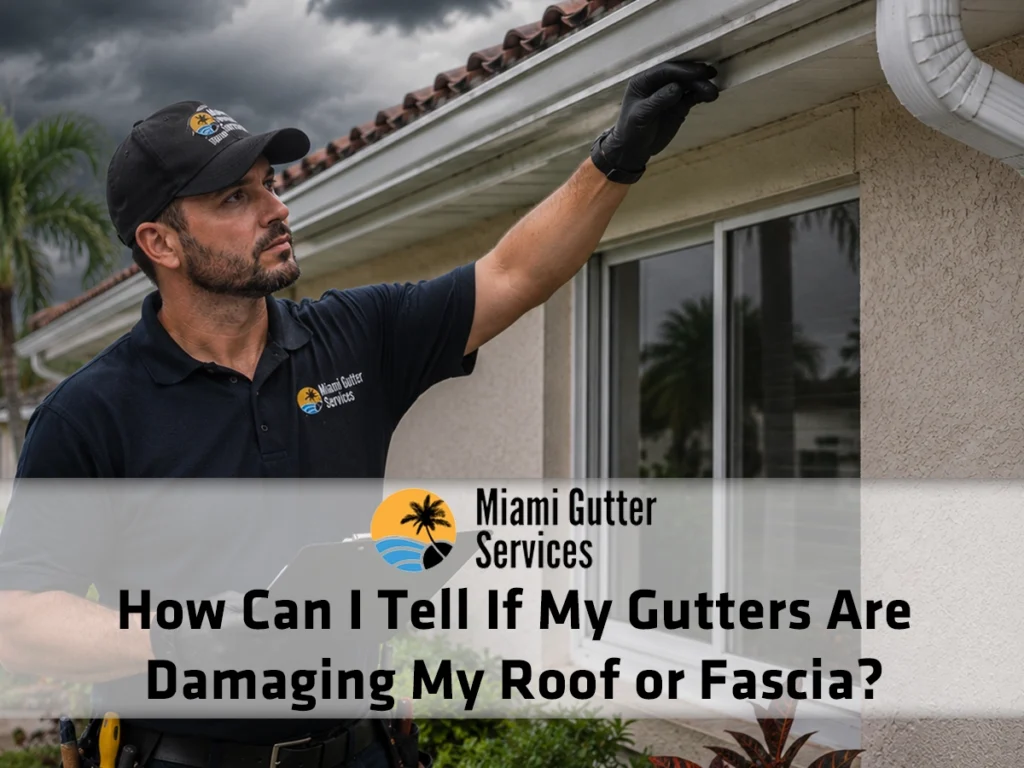
12 Powerful Warning Signs Miami Homeowners Should Never Ignore
A gutter can look secure from the ground while water is quietly damaging the wood behind it. In fact, peeling paint may be the first visible clue that repeated moisture has already reached the fascia.
AI Overview
You can tell that gutters may be damaging your roof or fascia when you see peeling paint, soft wood, water running behind the gutter, sagging sections, or gaps between the gutter and roof edge.
Other warning signs include lifting shingles, loose fasteners, dark stains, leaking seams, and gutters that tilt away from the house.
These problems often develop through a combination of clogged gutters, poor slope, blocked downspouts, loose hangers, damaged flashing, leaking joints, and storm damage.
Miami Gutter Services recommends checking the entire drainage system together. That inspection should cover the gutters, fascia, roof edge, soffits, slope, fasteners, seams, outlets, and downspouts.
When fascia wood is soft or rotted, it should be repaired or replaced before a gutter is reinstalled. New fasteners cannot provide reliable support when the material behind them is weak.
1. Why Gutter Damage Near the Roof Is Easy to Miss
Most homeowners look at the front of the gutter. However, some of the most serious damage develops behind the gutter, where it cannot be seen from the ground.
Water may slip between the gutter and fascia when the system is clogged, loose, poorly sloped, or incorrectly positioned. It can then wet the fascia board, soffit, roof edge, and nearby building materials.
Early damage may remain hidden because:
- The gutter covers much of the fascia board
- Paint may hide soft or swollen wood
- Water may only run behind the gutter during heavy rain
- Damage may begin near fasteners or seams
Therefore, homeowners should not rely on a quick visual check from the driveway.
A complete inspection is important because the gutter and roof edge work as one connected system. When one part fails, nearby parts often carry water or weight they were not designed to handle.
Miami Gutter Services considers roof pitch, overhang, fascia condition, and drainage when evaluating a gutter system. These factors influence how water reaches the gutter and how securely the system can be supported.
2. Peeling Paint Can Reveal Hidden Fascia Damage
Peeling paint near the roofline is one of the first warning signs homeowners often ignore.
Paint can lift when moisture repeatedly reaches the surface beneath it. The visible peeling may appear small, yet the wood behind the paint may already be swollen or beginning to soften.
Look for:
- Paint that bubbles, cracks, flakes, or separates
- Discolored areas beneath the gutter
- Fresh paint that begins peeling again
- Streaks running down from gutter fasteners
Repainting the fascia without correcting the water source is a common mistake.
Although fresh paint may improve the appearance, it will not stop water from flowing behind the gutter. As a result, the new coating may fail while the hidden wood continues to weaken.
The correct approach is to identify why the area stays wet. A technician should check the gutter slope, seams, fasteners, outlet, roof edge, and downspout before surface repairs begin.
If the fascia remains firm and dry, limited repair may be possible. However, soft or rotted sections require more than paint.
3. Soft or Rotted Fascia Is a Serious Structural Warning
The fascia board provides an attachment surface for many gutter systems. Therefore, its condition directly affects whether the gutter can remain secure during heavy rain.
Healthy fascia should feel solid. Damaged fascia may appear swollen, cracked, soft, stained, or uneven.
Signs of weakened fascia include:
- Screws that pull loose from the wood
- Gutter brackets that no longer sit firmly
- Wood that crumbles around attachment points
- Sections that bend or feel soft under light pressure
Homeowners should not press damaged fascia while standing on a ladder. A close inspection should be completed with proper access and safety equipment.
When fascia becomes weak, the gutter can lose support quickly. This is especially concerning when the channel fills with water and wet debris.
According to the field experience provided by Miami Gutter Services, damage can worsen very quickly when the fascia is already weak.
Therefore, damaged fascia should be repaired or replaced before the gutter is reinstalled. Attaching new hardware to rotted wood does not restore dependable support.
4. Water Running Behind the Gutter Points to a Drainage Failure
Water should enter the gutter from the roof edge. It should not flow between the gutter and fascia.
Water running behind the gutter may result from several connected problems.
Common causes include:
- A clogged channel that forces water over the back
- A gap between the gutter and fascia
- Improper gutter placement near the roof edge
- Damaged drip edge or flashing
- Loose hangers that allow the gutter to tilt
- Heavy flow passing over a poorly positioned gutter
During rain, safely observe where the water travels. Do not climb a ladder during a storm.
If water appears behind the gutter, note the affected section and inspect the wall below from ground level. Dark marks or peeling paint may help show where repeated overflow occurs.
This warning sign should be addressed before the next heavy rain. Continued moisture can reach the fascia, soffit, and roof edge.
The United States Environmental Protection Agency explains that controlling moisture is central to preventing indoor mold growth. Therefore, any water source affecting building materials should be corrected rather than covered.
5. A Gap Between the Gutter and Fascia Needs Attention
A small gap may not look urgent. However, it can allow water to miss the gutter or run behind it.
The gap may develop because:
- Fasteners have loosened
- Fascia wood has weakened
- The gutter has bent under excess weight
- Hangers were placed too far apart
- Storm winds moved the gutter
- The system was not installed in the correct position
A widening gap often indicates that the gutter is beginning to separate from its support.
Homeowners may notice daylight between the gutter and fascia. They may also see screws backing out or brackets hanging at an angle.
Pushing the gutter back toward the house is not a complete repair. The technician must determine why the separation happened.
If the wood is sound, the solution may involve new fasteners, improved hanger spacing, realignment, or section repair.
However, when the fascia is rotted, the support must be restored first. Otherwise, the same separation can return.
6. Sagging Gutters Can Damage the Fascia and Roof Edge
A gutter should maintain a controlled slope toward its downspouts. It should not dip sharply between hangers or lean away from the house.
Sagging often develops when the system carries too much weight.
That weight may come from:
- Standing water
- Wet leaves and branches
- Dirt and roof debris
- Plants growing in the channel
- Failed hangers or fasteners
- Bent gutter sections
A sagging gutter may hold water instead of draining it.
As more water collects, the weight increases. The gutter can then pull harder against the fascia, loosen more fasteners, and create a larger gap.
This cycle can lead to complete gutter failure or detachment.
Sagging should not be corrected by simply adding random screws. The technician should check the fascia, hanger spacing, gutter shape, slope, outlet, and downspout.
Read more about the most common gutter problems and how to fix them before a minor dip becomes a larger failure.
7. Lifting Roof Shingles May Signal Water or Installation Problems
Shingles near the roof edge should lie in their intended position and direct water toward the gutter.
When shingles lift, curl, or appear disturbed near the gutter, the cause should be inspected.
Possible issues include:
- Water backing up near the roof edge
- Gutter hardware affecting nearby materials
- Damaged drip edge or flashing
- Wind or storm damage
- Deteriorated roof edge materials
- Previous installation work that disturbed shingles
A gutter inspection cannot confirm the full condition of a roofing system. However, it can identify visible drainage issues that may be affecting the roof edge.
Miami Gutter Services has identified roof edge damage requiring roofing work as one of the serious outcomes seen when gutter problems are left too long.
Therefore, technicians should avoid making claims beyond the visible gutter system. When roofing materials require specialist evaluation, the homeowner should consult a qualified roofing professional.
Two important actions include:
- Correct the drainage source affecting the roof edge
- Have damaged roofing materials assessed by the proper trade
Ignoring lifting shingles may allow more moisture to reach vulnerable materials beneath them.
8. Loose Fasteners Can Show That the Fascia Is Failing
A loose screw does not always mean the hardware alone is defective.
Sometimes, the wood around the fastener has softened. In that case, installing another screw in the same damaged area may not provide a lasting solution.
Inspectors should look for:
- Screws backing out of the fascia
- Hangers that move under light pressure
- Enlarged holes around attachment points
- Cracked or crumbling wood
- Rust marks or stains near the hardware
Loose fasteners can also result from poor hanger spacing, excessive debris, standing water, or storm movement.
Therefore, the cause must be identified before repairs are made.
When the fascia remains sound, the repair may involve proper fasteners, new hangers, improved spacing, and corrected gutter alignment.
When the fascia is rotted, it should be repaired or replaced before the gutter is attached again.
This repair sequence protects the new gutter work and reduces the chance of another failure.
9. Dark Stains and Mildew May Point to Repeated Overflow
Dark marks below the gutter often show where dirty rainwater has repeatedly crossed the roof edge or exterior wall.
These stains may appear on:
- Fascia boards
- Soffit panels
- Stucco or siding
- Exterior trim
- Walls beneath gutter seams
- Areas near downspout connections
Staining alone does not prove that the material beneath it is rotted. However, it shows that water has traveled across an area often enough to leave a visible mark.
The moisture source should be identified before cleaning or painting begins.
The EPA states that mold can grow where moisture is present and that moisture control is the primary method of controlling indoor mold growth. Therefore, repeated wetting should be corrected promptly.
Useful next steps include:
- Check whether the gutter overflows during rain
- Inspect nearby seams and corners for leaks
- Confirm that the downspout accepts water
- Look for gaps behind the gutter
- Assess the fascia and soffit for softness
Cleaning the stain without fixing the drainage problem will not prevent it from returning.
10. Leaking Seams Can Keep the Fascia Wet
A seam, corner, end cap, or outlet may leak even when the rest of the gutter looks clear.
Small leaks can repeatedly wet the same section of fascia. Because the water volume may be limited, the problem can continue for months without creating dramatic overflow.
Common leak locations include:
- Inside and outside corners
- End caps
- Gutter section joints
- Downspout outlets
- Areas around loose fasteners
Sealant may fail as materials expand, contract, move, or age. Corrosion and physical damage can also create openings.
Adding sealant without cleaning and inspecting the joint may provide only a temporary result.
The technician should determine whether the leak comes from failed sealant, poor alignment, corrosion, separation, or a nearby blockage.
Seamless gutters reduce the number of joints along straight gutter runs. However, corners, end caps, and outlets still require proper installation and maintenance.
Homeowners comparing systems can review the advantages of seamless gutters in Miami.
11. Blocked Downspouts Can Push Water Toward the Roof Edge
A clear gutter cannot drain correctly when its outlet or downspout is blocked.
Water may collect until it reaches the back or front edge of the gutter. It can then spill onto the fascia, soffit, roof edge, or wall.
Signs of a blocked downspout include:
- Water standing in the gutter after rain
- Little water leaving the bottom outlet
- Overflow near one end of the gutter
- Leaks around elbows or joints
- Debris packed near the gutter outlet
A blockage may form from leaves, twigs, roof debris, animal nesting material, or compacted dirt.
Heavy rain does not always clear the obstruction. Instead, it may force material deeper into an elbow or narrow section.
The complete water path should be tested after debris removal.
That includes:
- The gutter channel
- The outlet opening
- Each downspout elbow
- The lower discharge point
- Any connected drainage extension
Learn how downspout repairs can help prevent water damage when the problem extends below the gutter.
12. Complete Gutter Detachment Is a Late Warning Sign
A gutter that detaches from the house has usually passed the early repair stage.
Complete or partial detachment may result from:
- Rotted fascia
- Failed fasteners
- Excess water and debris weight
- Bent gutter sections
- Wind or falling branches
- Long term sagging
- Poor original installation
A detached gutter can damage nearby property and create a safety risk. It may also pull at the roof edge or leave exposed holes in the fascia.
Do not stand beneath a loose section. Also, do not attempt to hold or remove a heavy gutter without suitable equipment.
The area should be secured and inspected.
Miami Gutter Services identified complete gutter failure, roof edge damage, and rotted fascia as the most serious outcomes commonly seen after warning signs were ignored.
At this point, the repair may require several coordinated steps:
- Remove the unsafe gutter section
- Inspect hidden fascia and roof edge damage
- Repair or replace weak support materials
- Address roofing concerns when present
- Install or restore a properly designed gutter system
Homeowners can compare their situation with these signs that gutters need immediate replacement.
13. Why Miami Weather Can Make Existing Damage Worse
Miami homes face frequent rain, high humidity, strong storms, and wind driven debris.
These conditions do not automatically mean every gutter will fail. However, they can expose weaknesses in clogged, loose, damaged, or poorly supported systems.
The National Weather Service Miami office provides current South Florida forecasts, storm information, climate resources, and hazard notices. Homeowners can use those resources when planning exterior inspections and maintenance.
Weather related concerns include:
- Heavy water volume entering a short gutter section
- Wind moving branches and roof debris
- Repeated moisture slowing the drying process
- Storms placing added stress on loose components
According to the experience provided for this article, fascia damage can worsen very quickly when the wood is already weak.
That is why waiting for another storm is risky. A gutter that stayed attached during the last rain may fail when the next storm adds more water and debris.
Review these steps to prepare gutters before hurricane season and reduce avoidable drainage problems.
14. What Miami Gutter Services Checks During an Inspection
A proper inspection should not focus only on the most visible stain or loose screw.
Miami Gutter Services checks the full gutter and drainage system before explaining whether repair or replacement is the better option.
The inspection includes:
- Gutter slope and water flow
- Hangers and fasteners
- Fascia behind the gutter
- Roof shingles near the edge
- Drip edge and flashing
- Soffit areas
- Downspouts and outlets
- Seams, corners, and end caps
This process helps determine whether the visible defect is an isolated issue or one part of a larger failure.
For example, a sagging section may be caused by loose hangers. However, it may also involve rotted fascia, standing water, poor slope, and a blocked downspout.
The team also looks behind the gutter for hidden fascia damage when access and conditions allow.
Most importantly, Miami Gutter Services avoids attaching a repaired or replacement gutter until the supporting fascia is sound.
The company states that roof pitch, overhang, fascia, and material selection are considered when planning gutter installation or replacement.
15. When Can a Gutter Be Repaired?
Repair may be practical when the damage is limited and the supporting structure remains sound.
Possible repair conditions include:
- A small number of loose hangers
- Limited seam or corner leaks
- Minor alignment problems
- A blocked outlet or downspout
- A short damaged section
- Sound fascia behind the gutter
Repairs may involve cleaning, resealing, replacing fasteners, correcting slope, adding proper hangers, or replacing a limited section.
However, repair should address the cause rather than only the visible symptom.
For example, resealing a seam will not solve standing water caused by poor slope. Likewise, new screws will not hold securely in rotted fascia.
Miami Gutter Services offers gutter repair and maintenance services across South Florida and describes more than 20 years of experience on its repair page.
16. When Is Gutter Replacement the Better Choice?
Replacement may provide better value when damage is widespread or repeated repairs no longer produce reliable drainage.
Replacement may be considered when:
- Several sections sag or separate
- The gutter has lost its correct shape
- Corrosion affects large areas
- Leaks continue across many joints
- The system has poor capacity or design
- Fastener failure occurs throughout the run
- The gutter has detached from weakened fascia
Before replacement begins, the roof edge and fascia must be checked.
Installing a new gutter over damaged wood may hide the problem without solving it. Therefore, structural support should be restored first.
Miami Gutter Services states that its team evaluates the roof pitch, overhang, fascia, material, and property needs when designing a replacement system.
Two key goals should guide replacement:
- Restore controlled drainage from the roof
- Provide secure support for the new gutter
17. Why Unsafe Do It Yourself Repairs Can Make Damage Worse
Gutter and fascia problems often occur above uneven ground, landscaping, pavement, or entryways.
Homeowners may also encounter wet debris, insects, sharp metal, loose gutters, and unstable roof edges.
Common unsafe actions include:
- Climbing during rain
- Leaning beyond the ladder rails
- Resting a ladder against a loose gutter
- Pulling on a detached section
- Walking on a wet roof
- Reaching behind the gutter without seeing the area
A person may also repaint or seal the visible area without finding the actual source.
Therefore, do it yourself work can create two risks. First, the person may be injured. Second, the repair may hide damage while water continues entering the roof edge.
A safe professional inspection allows the full system to be assessed before repair choices are made.
18. What Should You Do When You Notice Warning Signs?
Take action before the next heavy rain.
Start with observations that can be made safely from the ground.
Document:
- Peeling paint near the roofline
- Water flowing behind the gutter
- Gaps between the gutter and fascia
- Sagging or tilted sections
- Loose screws or hangers
- Lifting shingles near the edge
- Dark stains or mildew marks
Then, schedule a complete inspection.
Ask the technician to check the gutter, fascia, roof edge, slope, fasteners, seams, outlets, and downspouts together.
If the fascia is soft or rotted, repair or replace it before reinstalling the gutter.
Finally, avoid painting, sealing, or pushing the gutter back into place until the water source and support condition are understood.
Frequently Asked Questions
1. How can I tell if my gutters are damaging my roof or fascia?
Look for peeling paint, soft fascia wood, water behind the gutter, lifting shingles, gaps, and sagging sections. Loose fasteners and dark stains may also indicate repeated moisture. Because much of the fascia remains hidden, a professional inspection may be needed to confirm the damage.
2. Can water behind a gutter damage fascia boards?
Yes. Water flowing behind a gutter can repeatedly wet the fascia board. Over time, the wood may swell, soften, or rot. The damage can also weaken the attachment points holding the gutter. The water source should be corrected before the fascia is painted or repaired.
3. Why is my gutter pulling away from the fascia?
A gutter may pull away because of loose hangers, wet debris, standing water, storm damage, poor installation, or weakened fascia. Several problems may occur together. A technician should inspect the supporting wood, fasteners, slope, gutter shape, outlets, and downspouts before recommending repairs.
4. Should rotted fascia be repaired before gutter replacement?
Yes. Rotted fascia should be repaired or replaced before a new gutter is attached. New hangers cannot provide reliable support when the material behind them is soft or damaged. Restoring the fascia first helps protect the gutter installation and reduces the risk of another separation.
5. Can clogged gutters damage the roof edge?
Clogged gutters can cause water to back up, overflow, or run behind the channel. Repeated moisture may affect fascia, soffits, flashing, and materials near the roof edge. However, a roofing professional may be needed when shingles, decking, or other roofing components require detailed evaluation.
6. Is peeling paint on fascia only a cosmetic problem?
Not always. Peeling paint may indicate that moisture has reached the surface beneath it. Repainting without correcting the gutter leak or overflow can hide the issue temporarily. The gutter, seams, slope, fasteners, fascia, and downspouts should be checked before cosmetic repairs begin.
7. Can sagging gutters cause roof or fascia damage?
Yes. Sagging gutters may hold standing water and wet debris. The added weight can loosen fasteners and pull against the fascia. A sagging section can also change the gutter slope, causing more water to collect. The cause should be corrected before the gutter becomes detached.
8. What should a gutter and fascia inspection include?
The inspection should include gutter slope, water flow, hangers, fasteners, seams, corners, end caps, outlets, downspouts, fascia, soffits, roof edge, shingles, drip edge, and flashing. Checking the entire drainage path helps identify connected problems rather than treating only the most visible symptom.
Conclusion
How can I tell if my gutters are damaging my roof or fascia?
Begin by looking for peeling paint, soft wood, water behind the gutter, lifting shingles, small gaps, loose fasteners, and sagging sections.
These warning signs may develop through several connected problems. A blockage, poor slope, loose hanger, leaking seam, blocked downspout, damaged drip edge, and weak fascia can all contribute to the same failure.
Therefore, the gutter should not be inspected in isolation.
Miami Gutter Services recommends checking the gutter, fascia, roof edge, slope, fasteners, seams, outlets, and downspouts together. This approach helps reveal the true water source and any hidden support damage.
Most importantly, damaged fascia should be repaired or replaced before a gutter is reinstalled. A sound support surface is essential for safe and reliable gutter performance.
Early action can often limit the repair. However, waiting may lead to rotted fascia, roof edge damage, and complete gutter detachment.
Schedule a Complete Gutter and Fascia Inspection
Do not cover peeling paint or push a sagging gutter back into place without checking the cause.
Miami Gutter Services can inspect the full drainage system, explain the visible findings, and help determine whether repair or replacement is the better option.
Contact us at
Phone: 786 882 4945
Location: 1177 SW 8th St, Miami, FL 33130
Website: www.miamiguttercompany.com