
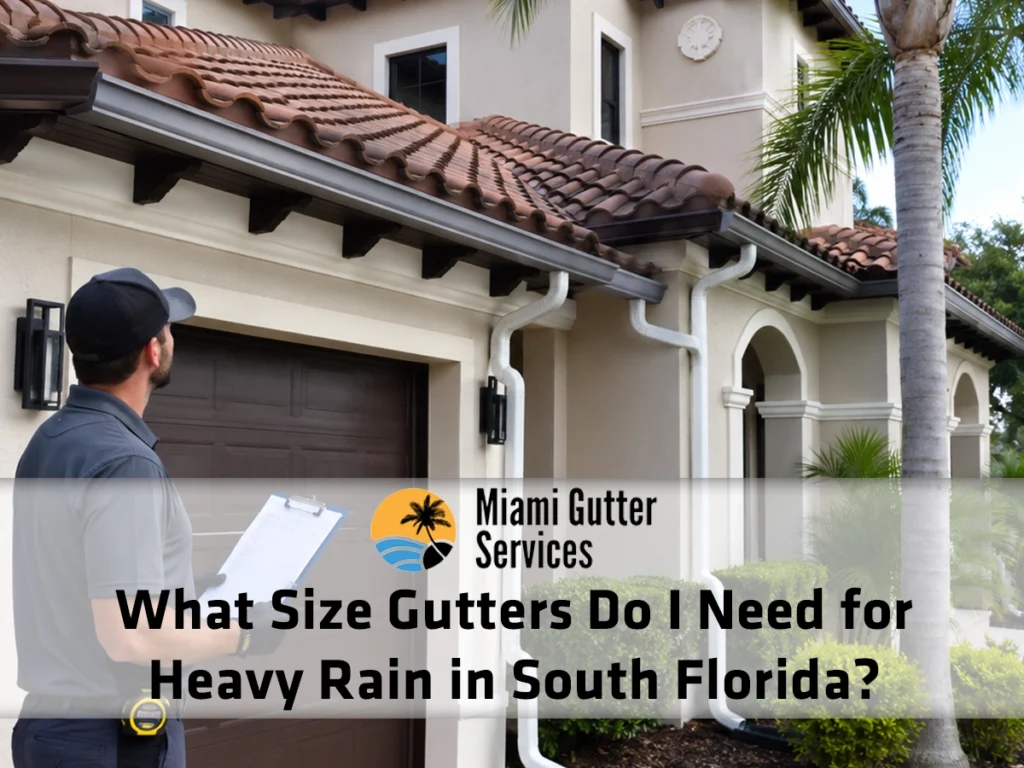
12 Powerful Gutter Sizing Facts for Heavy Rain
Nearly 70 percent of South Florida’s average yearly rain can fall during the five month rainy season. That means a large amount of roof runoff may reach your gutters within a short period.
AI Overview
What size gutters do I need for heavy rain in South Florida?
There is no single size that works for every home. Some smaller roof sections may perform well with standard gutters. However, larger, steeper, or more complex roof areas may need six inch gutters, larger outlets, extra downspouts, or another custom setup.
The correct choice depends on roof area, roof pitch, valleys, gutter length, overflow history, outlet size, downspout placement, and the final water discharge point.
Before increasing gutter size, Miami Gutter Services first checks whether leaves, roof debris, poor slope, or a blocked downspout are causing the overflow. A clogged standard gutter can appear too small even when its original size is suitable.
A professional sizing inspection should measure each roof section. The gutters, outlets, and downspouts should then be planned as one complete drainage system.
1. Why Gutter Size Matters During South Florida Rain
A gutter must collect water from the roof and move it toward an outlet before the channel overflows.
During light rain, even a poorly planned system may appear to work. However, heavy South Florida storms can expose weak points very quickly.
Miami Dade County warns that heavy rainfall can overwhelm drainage within minutes. Although public drainage and residential gutters serve different purposes, both must handle concentrated water safely.
An effective roof drainage system must accomplish three tasks:
- Catch water as it leaves the roof
- Carry that water through the gutter
- Release it through suitable downspouts
If one part is too small or blocked, the whole system can struggle.
For example, a large gutter may still overflow when its outlet is narrow. Likewise, a large downspout cannot help when debris blocks the gutter above it.
Therefore, gutter width alone does not determine performance.
2. Is a Five Inch Gutter Large Enough?
A standard five inch gutter may be suitable for smaller or simpler roof sections.
However, its performance depends on more than its width.
A five inch system may work when:
- The roof area feeding the gutter is limited
- The roof pitch does not create extreme runoff speed
- Downspouts are placed at suitable intervals
- Roof valleys do not send excess water into one point
- Gutters and outlets remain clear
Homeowners should not assume that every South Florida house automatically needs oversized gutters.
Larger systems may add capacity, but they also require proper support, suitable fascia, correct slope, and an effective downspout plan.
Miami Gutter Services evaluates the property before recommending a size. The company considers roof pitch, overhang, fascia, material, and the needs of the home when planning installation.
A five inch gutter may be enough for one side of a home but not another.
That is why sizing should be based on each roof section.
3. When Are Six Inch Gutters a Better Choice?
Six inch gutters provide more channel capacity than common five inch systems.
They may be useful for:
- Larger roof sections
- Steep roof slopes
- Long gutter runs
- Areas below major roof valleys
- Properties with repeated heavy rain overflow
However, six inch gutters should not be treated as an automatic upgrade for every home.
A wider gutter cannot correct poor slope, clogged outlets, weak fascia, or badly placed downspouts.
Before recommending a larger system, Miami Gutter Services checks whether the existing gutter is actually undersized.
That process includes:
- Cleaning leaves and debris
- Inspecting the outlets
- Checking downspouts for hidden blockages
- Reviewing gutter slope
- Measuring the contributing roof area
If overflow continues after those issues are corrected, increased capacity may be appropriate.
4. Why Different Roof Sections May Need Different Sizes
A house may have several roof areas with very different drainage demands.
One small roof edge may receive water from a simple slope. Another section may sit below two roof surfaces and a valley.
As a result, using the same gutter design everywhere may not produce the best performance.
Important differences include:
- The roof area above each gutter section
- The direction of water flow
- The number of valleys
- The gutter length between downspouts
- The location of upper roof runoff
Miami Gutter Services may recommend different sizing or outlet arrangements based on each section.
For example, one side may work with a standard system and well placed downspouts. Another side may need a larger gutter, larger outlet, or extra downspout near a valley.
This custom approach avoids unnecessary upgrades while improving capacity where it matters.
5. How Roof Area Affects Gutter Capacity
Roof area determines how much rainwater may reach a gutter section.
A large roof surface collects more water than a small porch or garage roof.
However, installers should not use the total house size alone.
They must identify which roof area drains into each individual gutter run.
Important questions include:
- How much roof feeds this section?
- Does another roof level add more runoff?
- Does a valley direct extra water into this area?
- How far must the water travel before reaching an outlet?
A gutter serving a small roof edge may have modest demand.
In contrast, a long rear gutter may receive water from a broad roof plane and several valleys.
This is why Miami Gutter Services measures roof sections instead of guessing.
6. How Roof Pitch Changes Water Flow
Roof pitch affects how quickly water reaches the edge.
A steeper roof can move water faster than a low slope roof. During intense rain, fast runoff may shoot beyond a narrow or poorly positioned gutter.
Signs of this problem include:
- Water passing over the front edge
- Overflow concentrated below a steep slope
- Splashing near the roofline
- Soil erosion directly below the gutter
A steeper roof does not always require the largest gutter available.
The installer must also consider gutter placement, roof overhang, outlet size, and downspout location.
Miami Gutter Services includes roof pitch in its installation assessment because it affects both flow and system placement.
Two useful design goals are:
- Catch runoff as it leaves the roof
- Move it to an outlet without creating a bottleneck
7. Why Roof Valleys Need Special Attention
Roof valleys collect water from two adjoining roof surfaces.
During heavy rain, that concentrated flow may reach one short gutter section with considerable force.
Common valley related problems include:
- Overflow beneath the valley
- Water shooting past the gutter
- Debris collecting near the impact area
- Fast gutter filling during storms
A homeowner may assume the entire gutter is too small. However, the main problem may exist at one concentrated point.
Possible solutions include:
- Increasing capacity in that section
- Adding an outlet or downspout nearby
- Improving gutter position
- Clearing debris around the valley
- Reviewing the roof drainage path
A professional sizing inspection can identify whether the valley needs a different configuration from the rest of the roof.
8. Why Long Gutter Runs Can Overflow
A long gutter run must move water across a greater distance before it reaches a downspout.
When too much roof area drains into one long section, water may collect faster than it can leave.
Warning signs include:
- Overflow near the middle of the run
- Standing water after rain
- Sagging between hangers
- Slow drainage toward the outlet
Adding a larger gutter may help in some cases.
However, more or larger downspouts may provide a better solution when the main problem is limited discharge capacity.
The full assessment should review:
- Gutter length
- Gutter slope
- Number of outlets
- Outlet locations
- Downspout capacity
This is why gutters and downspouts must be sized together.
9. Why Downspout Size Matters as Much as Gutter Size
A gutter can only drain as quickly as its outlets and downspouts allow.
If the outlet is too small, water may back up inside a large gutter.
Likewise, a narrow downspout may restrict flow during intense rain.
An effective heavy rain setup may use:
- Larger downspouts with larger gutters
- Additional downspouts on long runs
- Extra outlets near roof valleys
- Downspouts placed near major flow areas
- Suitable discharge points away from the home
Federal building guidance describes gutters and downspouts as a complete roof runoff management system. It also stresses directing water away from the building rather than allowing it to saturate soil near the foundation.
The downspout plan should answer three questions:
- How quickly can water leave the gutter?
- Where will the downspout carry it?
- Can the ground discharge area accept the flow?
10. Why Outlet Size Can Create a Hidden Bottleneck
The gutter outlet connects the gutter channel to the downspout.
A small or blocked outlet may restrict water before it even reaches the downspout.
Signs of an outlet problem include:
- Water collecting above one downspout
- Overflow close to the outlet
- Little water leaving the bottom
- Debris packed around the opening
Increasing gutter width without improving the outlet may not solve the problem.
A proper inspection should check:
- Outlet opening size
- Outlet location
- Debris around the opening
- Connection to the downspout
- Water flow through the first elbow
Miami Gutter Services sizes gutters, outlets, and downspouts as one connected system.
This approach prevents one narrow component from limiting the rest.
11. Why Debris Is Often the Real Cause of Overflow
Based on the experience provided by Miami Gutter Services, leaves and debris are a common cause of overflow during heavy rain.
A blocked gutter can appear undersized because water cannot reach the outlet.
Common debris includes:
- Leaves and twigs
- Roof granules
- Dirt and pollen
- Seeds and plant growth
- Bird nesting material
Heavy rain may pack this material more tightly rather than washing it away.
Therefore, Miami Gutter Services cleans and tests the system before recommending larger gutters.
A correct inspection includes:
- Clearing the gutter channel
- Opening each outlet
- Checking every downspout
- Reviewing the gutter slope
- Testing the flow again
If the cleaned system performs correctly, replacement may not be necessary.
Homeowners should review these overlooked gutter maintenance tips before assuming the system needs greater capacity.
12. How to Tell If Gutters Are Truly Too Small
Several warning signs appearing together may indicate that a gutter system lacks enough capacity.
Possible signs include:
- Overflow during heavy rain
- Water shooting past the front edge
- Fast filling near roof valleys
- Slow downspout drainage
- Standing water after the storm
- Soil erosion below the roofline
- Repeated fascia or soffit stains
However, these signs do not prove that size is the only problem.
Overflow may also result from:
- Clogs
- Poor slope
- Too few downspouts
- Small outlets
- Loose gutters
- Damaged fascia
A professional should inspect and test the system before recommending replacement.
That process helps separate a true capacity issue from a repair or maintenance issue.
13. Why Gutter Slope Affects Heavy Rain Performance
Gutters require a controlled slope toward their outlets.
When the slope is too flat, water may move slowly and collect during intense rain.
When the slope is uneven, water may sit in low areas.
Signs of slope problems include:
- Standing water inside the gutter
- Debris collecting in one section
- Overflow away from the downspout
- Visible dips or sagging
A larger gutter may hold more standing water without correcting the reason it remains.
Therefore, the slope should be checked before increasing size.
Possible solutions include:
- Realigning the gutter
- Replacing damaged hangers
- Correcting loose fasteners
- Repairing weak fascia
- Moving or adding an outlet
A sound system needs both capacity and proper flow.
14. Why Fascia Strength Matters With Larger Gutters
Larger gutters can hold more water.
That extra capacity also means the system may carry greater weight during heavy rain.
The fascia and fastening points must be able to support that load.
Warning signs of weak fascia include:
- Soft or rotted wood
- Peeling paint
- Loose fasteners
- Gaps behind the gutter
- Sections pulling away
Miami Gutter Services evaluates fascia condition before designing a new system. Its installation guidance lists fascia among the key property factors that should be considered.
If the fascia is damaged, it should be repaired before a larger gutter is attached.
A strong gutter cannot remain secure on a weak support surface.
15. When Larger Gutters Offer Real Benefits
Larger gutters can improve performance when the roof truly produces more runoff than a standard system can manage.
Potential benefits include:
- Greater water capacity
- Better performance below roof valleys
- Improved handling of steep roof runoff
- Less overflow along long gutter runs
- Better flow when paired with larger downspouts
They may also help protect:
- Fascia and soffits
- Exterior walls
- Landscaping
- Walkways
- Ground near the foundation
However, larger gutters should be installed as part of a complete design.
Simply increasing gutter width without reviewing outlets and downspouts can leave the same drainage bottleneck.
16. When Standard Gutters May Still Be Enough
Standard gutters may remain suitable when the roof area is modest and the system is properly designed.
They may perform well when:
- Gutters remain clear
- Slope is correct
- Downspouts are sufficient
- Valleys do not overload one point
- Outlets are large enough
- The fascia provides sound support
A homeowner should not replace a functional system only because another home uses larger gutters.
Different homes have different roof shapes and drainage needs.
Miami Gutter Services explains when standard gutters are enough and when a larger system is justified.
This helps homeowners avoid paying for capacity that the property does not require.
17. Why Copying the Old Gutter Size Can Be a Mistake
Replacing old gutters with the same size may repeat the original problem.
The existing design may have:
- Too few downspouts
- Small outlets
- Poor valley placement
- Incorrect slope
- Limited capacity
- An unsuitable discharge plan
Before copying the old setup, the installer should review the roof and drainage history.
Important questions include:
- Where did overflow occur?
- Did water pool below certain downspouts?
- Were gutters frequently clogged?
- Did one roof section fail more often?
The new design should correct known problems instead of recreating them.
Homeowners planning replacement can review these signs that gutters need immediate replacement.
18. Why Appearance Should Not Decide Gutter Size
Gutters should complement the property, but appearance should not control sizing.
A smaller gutter may look less noticeable. However, it may not provide enough capacity for a large roof section.
A very large system may provide unnecessary capacity on a simple roof.
The decision should consider:
- Roof dimensions
- Runoff speed
- Valley flow
- Downspout capacity
- Fascia strength
- Architectural style
Material and color can then be selected within the correct performance range.
Miami Gutter Services offers systems designed around both property needs and style preferences.
19. How Seamless Gutters Fit Into the Sizing Plan
Seamless gutters are formed in long sections for the property.
They reduce the number of joints along straight runs.
Potential advantages include:
- Fewer straight run seam locations
- A clean exterior appearance
- Custom lengths
- Sizing based on the home
However, seamless construction does not replace proper sizing.
A seamless gutter can still overflow when:
- It is too small
- The outlet is blocked
- Downspouts are insufficient
- The slope is incorrect
- Debris restricts flow
Homeowners can learn more about the benefits of seamless gutters in Miami.
20. How Gutter Guards Affect Heavy Rain Flow
Gutter guards may help reduce certain debris, especially on properties near trees.
However, guards must be selected carefully.
A poorly matched guard may allow water to pass over the gutter during intense rain.
The inspection should consider:
- Roof pitch
- Rainfall intensity
- Debris type
- Guard opening design
- Valley flow
- Maintenance access
Guards should not be installed over clogged or damaged gutters.
The system should first be cleaned, repaired, and tested.
Homeowners should also remember that guards do not remove all maintenance needs.
Read about the warning signs of a failing gutter guard before adding one to a heavy rain system.
21. Why Final Water Discharge Matters
Gutter sizing is only part of water management.
The downspouts must release water in a suitable area.
A high capacity system can move a large volume of water quickly. If that water is released beside the home, it may create erosion or pooling.
Federal building guidance recommends directing roof runoff away from the building and notes that unmanaged roof water can quickly saturate nearby soil.
Miami Dade also notes that heavy rain can overwhelm local drainage and cause rapid standing water.
The final plan should consider:
- Distance from the home
- Ground slope
- Soil condition
- Walkways
- Landscaping
- Neighboring properties
22. What Miami Gutter Services Checks During Sizing
Miami Gutter Services follows a measured process before recommending gutter size.
The team checks:
- Roof area
- Roof pitch
- Valleys
- Long gutter runs
- Multiple roof levels
- Existing overflow areas
- Outlet size
- Downspout quantity
- Downspout location
- Final discharge points
The team also checks whether debris or hidden blockages are causing the problem.
After cleaning, the system can be tested again.
This process helps the team explain whether the property needs:
- Standard gutters
- Larger gutters
- More downspouts
- Larger outlets
- Better slope
- A combination of improvements
The goal is to select the correct system rather than the largest available option.
23. What a Professional Sizing Inspection Should Include
A professional inspection should examine the entire water path.
It should begin at the roof and continue to the ground.
A complete review includes:
- Measuring contributing roof sections
- Reviewing roof pitch
- Locating major valleys
- Measuring gutter runs
- Checking fascia condition
- Inspecting existing gutters
- Opening outlets
- Testing downspouts
- Reviewing discharge areas
The technician should also discuss prior problems.
Homeowners should report:
- Where overflow occurs
- Which storms cause it
- Where water pools
- Whether the gutter remains full after rain
- How often debris builds up
These details help connect the measurements to actual field performance.
24. Questions to Ask Before Choosing Gutter Size
Before approving installation, ask the contractor clear questions.
Useful questions include:
- How much roof area drains into this section?
- Why is this gutter size recommended?
- How many downspouts will be installed?
- Are the outlets sized for the downspouts?
- How will roof valleys be handled?
- Where will each downspout release water?
The contractor should be able to explain the system as one complete design.
A recommendation based only on appearance or a quick guess may miss important drainage conditions.
25. The Best Final Recommendation
What size gutters do I need for heavy rain in South Florida?
The correct answer depends on the home.
Some roof sections may work with standard gutters. Others may need six inch gutters, larger outlets, more downspouts, or a custom combination.
The final decision should be based on:
- Roof area
- Roof pitch
- Valleys
- Long runs
- Existing overflow
- Outlet capacity
- Downspout placement
Most importantly, schedule a professional sizing inspection before installation.
That inspection can confirm whether the existing gutter is too small or simply blocked, damaged, or poorly configured.
Frequently Asked Questions
1. What size gutters do I need for heavy rain in South Florida?
The correct size depends on roof area, pitch, valleys, gutter length, and downspout capacity. Standard gutters may work on smaller roof sections. Larger or six inch gutters may suit roofs with heavier runoff. A professional inspection should measure each section before selecting a size.
2. Are six inch gutters better for South Florida homes?
Six inch gutters provide more capacity than common five inch systems. They may help on large, steep, or complex roofs. However, they are not automatically better for every home. Outlet size, downspouts, slope, fascia condition, and debris control must also support the larger system.
3. How do I know whether my gutters are too small?
Possible signs include repeated overflow, water shooting past the edge, fast filling near valleys, slow downspout drainage, erosion, and fascia stains. However, clogs and poor slope can create the same signs. The system should be cleaned and tested before replacement.
4. Can clogged gutters look undersized?
Yes. Leaves and debris can restrict flow and make a suitable gutter overflow. The gutter channel, outlets, and downspouts should be cleaned before capacity is judged. If overflow continues after cleaning and proper flow testing, the system may require a larger size or better configuration.
5. Do larger gutters need larger downspouts?
Larger gutters often perform best with outlets and downspouts designed for their added capacity. A narrow outlet or small downspout can become a bottleneck. The gutter, outlet, and downspout should always be sized as one complete drainage system.
6. Do roof valleys require larger gutters?
Roof valleys can send concentrated water into a short gutter section. That area may need more capacity, a larger outlet, an extra downspout, or improved gutter placement. The correct solution depends on the roof area, valley design, runoff speed, and existing overflow pattern.
7. Can I use different gutter sizes on the same house?
Yes. Different roof sections may have different runoff demands. A small porch may need less capacity than a long roof section below several valleys. A custom inspection can determine whether different gutter sizes or downspout layouts are appropriate.
8. Does roof pitch affect gutter size?
Yes. A steeper roof can move water toward the edge more quickly. This may affect gutter capacity, placement, and downspout needs. Roof pitch should be reviewed together with roof area, valleys, overhang, fascia, and prior overflow problems.
9. Are seamless gutters better for heavy rain?
Seamless gutters reduce joints along straight runs, but they must still be sized correctly. Heavy rain performance depends on width, slope, outlets, downspouts, support, and maintenance. A seamless gutter can still overflow when it is clogged or poorly configured.
10. Should I schedule a gutter sizing inspection?
Yes. A professional inspection measures roof areas, reviews pitch and valleys, checks blockages, tests flow, and plans downspouts. This process helps determine whether standard gutters are enough or whether larger components are needed for reliable heavy rain performance.
Conclusion
What size gutters do I need for heavy rain in South Florida?
There is no universal answer.
The right gutter size depends on how much roof area feeds each section, how quickly water moves, and how well the outlets and downspouts release it.
Standard gutters may be enough for smaller or simpler roof areas.
Larger gutters may benefit steep roofs, long runs, large roof sections, and areas below major valleys.
However, overflow does not always mean the gutter is too small.
Leaves, debris, poor slope, small outlets, blocked downspouts, and weak support can all create similar problems.
Therefore, Miami Gutter Services first checks and tests the existing drainage path.
The team measures roof areas, reviews pitch and valleys, sizes outlets and downspouts, and explains when standard or larger gutters are appropriate.
Most importantly, schedule a professional gutter sizing inspection before installation.
A measured design can improve water flow without relying on guesswork or unnecessary upgrades.
Schedule a Professional Gutter Sizing Inspection
Prepare your property for South Florida’s heavy rain with a system designed around your actual roof and drainage needs.
Miami Gutter Services can inspect your roof sections, identify flow restrictions, and recommend the correct combination of gutters, outlets, and downspouts.
Contact us at
Phone: 786 882 4945
Location: 1177 SW 8th St, Miami, FL 33130
Website: www.miamiguttercompany.com