
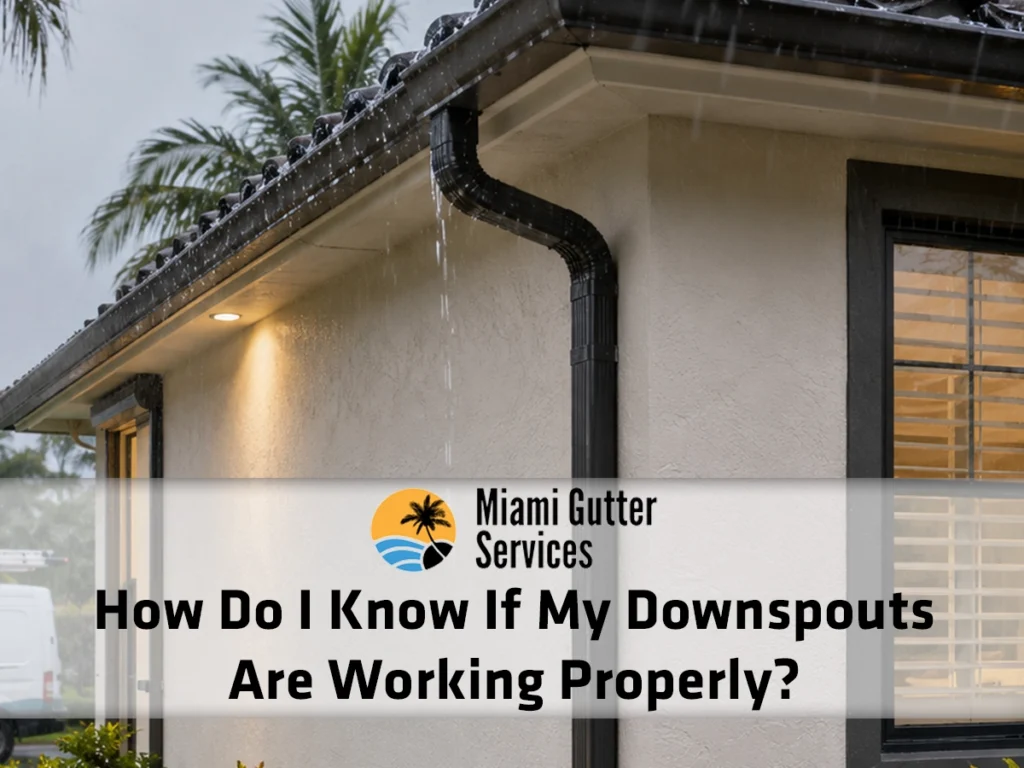
How Do I Know If My Downspouts Are Working Properly?
A Simple Guide to Reliable Downspout Performance
Miami receives an annual rainfall normal of about 67.41 inches, according to National Weather Service climate data. That amount of water places constant pressure on gutters and downspouts, especially during strong summer storms. A downspout may look fine from the ground while leaves, roof grit, loose joints, or damaged parts quietly reduce its flow.
AI Overview
A properly working downspout should carry roof water through the gutter system and release it safely away from the building. During rain, water should leave the downspout in a steady flow without spilling over the gutter, leaking from joints, or collecting beside the foundation.
Common warning signs include gutter overflow, water pooling near exterior walls, soil erosion, stained stucco, mildew, peeling paint, and dripping downspout seams. Homeowners can watch the system during rain, but hidden or hard to reach blockages should be inspected by a professional.
Miami Gutter Services checks the entire gutter and downspout system before recommending repairs. The inspection may include running water through the gutter, watching the outlet flow, checking joints, removing debris, and confirming that discharged water travels away from the home.
1. What Does a Working Downspout Actually Do?
A downspout is more than a vertical pipe attached to a wall. It is the final delivery point in the roof drainage system.
- It receives rainwater collected by the gutters.
- It directs that water toward a safe drainage area.
When the system works correctly, rain moves from the roof into the gutter channel. Next, the gutter slope guides the water toward an outlet. Finally, the downspout carries it toward the ground.
The United States Environmental Protection Agency explains that downspouts influence where roof runoff travels after a storm. Poor discharge placement can send water onto paved areas, toward streets, or into unsuitable drainage locations. Therefore, downspout direction matters as much as water flow.
A working downspout should show several clear traits.
- Water reaches the outlet without spilling over the gutter edge.
- Water exits without leaking through seams, elbows, or loose connections.
- Water drains away from exterior walls and the foundation.
- The outlet does not create severe erosion in the landscaping.
However, a clear outlet does not always mean the entire system works properly. A gutter may have the wrong slope. Likewise, a downspout may be too small for the amount of water reaching it.
For that reason, Miami Gutter Services checks the full gutter and downspout system before suggesting repairs.
2. Seven Powerful Signs Your Downspouts Are Working
You do not need to dismantle the system to notice good drainage. Instead, watch how the gutters perform during steady rain.
- Look at the gutter, joints, and outlet area.
- Check where the discharged water travels after it exits.
1. Water Leaves in a Strong and Steady Flow
Water should exit the bottom of the downspout without long pauses. A weak trickle during strong rain may point to a partial blockage.
However, flow strength depends on rainfall and roof size. Therefore, compare the outlet flow with the amount of rain falling at that moment.
2. The Gutters Do Not Overflow
Overflow is one of the clearest signs that something is wrong. Water may spill over because leaves or roof grit block the downspout opening.
In other cases, the gutter may be holding more water than one downspout can manage.
3. The Joints Stay Dry
Downspout seams, elbows, and connections should not spray or drip heavily. Small leaks often start where sections become loose.
Although a small drip may appear minor, repeated water contact can stain stucco and keep nearby surfaces damp.
4. Water Moves Away From the Building
A downspout should not empty directly beside the wall without suitable drainage. Instead, an extension or outlet should move water toward an appropriate release point.
FEMA advises homeowners to maintain gutters, downspouts, and splash pads so roof water can move easily away from the home.
5. There Is No Pooling Near the Foundation
After rain, inspect the area below each downspout. Standing water may mean the extension is missing, too short, disconnected, or poorly placed.
Pooling can also occur when the ground does not drain well.
6. The Landscaping Is Not Washing Away
A strong downspout flow can still cause trouble when it strikes bare soil. Look for exposed roots, washed mulch, small channels, or displaced gravel.
Those signs show that the water needs better direction or slower release.
7. The Exterior Wall Remains Clean
Water stains, mildew, and peeling paint can develop when a loose joint repeatedly wets the wall.
Therefore, clean stucco near the downspout often indicates that the seams and outlet are doing their job.
3. Six Alarming Signs Your Downspouts Need Attention
Many downspout problems become visible during heavy rain. Others appear after the storm has passed.
- Watch for active overflow and leaking.
- Inspect the wall, soil, and foundation area afterward.
1. Water Spills Over the Gutter
Water spilling over the gutter may indicate that the downspout opening is blocked. Leaves, roof grit, and compacted debris can collect near the outlet.
This problem may look like a gutter capacity issue. However, cleaning the downspout may restore normal flow.
The article about common gutter problems and practical solutions explains why overflow should never be ignored.
2. Water Pools Near the Foundation
A downspout can move water quickly and still fail its main purpose. This happens when the outlet releases water too close to the home.
A missing or damaged extension is often the cause. In addition, the extension may point toward a low area where water naturally collects.
3. Soil or Mulch Washes Away
Erosion below the outlet shows that water is striking one area with too much force.
Over time, the soil may form a visible channel. As a result, landscaping can shift, roots can become exposed, and drainage patterns may change.
4. Stucco Develops Stains or Mildew
Dark streaks, green growth, or peeling paint near a downspout may point to a leaking seam.
The problem can also come from water spilling over the gutter directly above that area.
5. Water Leaks From Downspout Joints
Loose joints are common repair points. Screws may loosen, sealant may fail, or sections may separate slightly.
Fortunately, a small joint problem does not always require complete replacement.
6. The Downspout Looks Bent or Cracked
A crushed section reduces the space available for water. Likewise, cracks allow water to escape before reaching the outlet.
Several damaged sections may make replacement more practical than repeated repairs.
4. How to Test a Downspout With Water
Miami Gutter Services uses a direct water test as part of the inspection process.
- Water is introduced into the gutter with a hose.
- The team tracks how the water moves through every visible section.
A controlled hose test can reveal problems that remain hidden during dry weather. However, homeowners should only perform this test where access is safe.
Step 1: Run Water Into the Gutter
Water should enter the gutter at a moderate rate. Then, it should move toward the outlet without collecting in one section.
Standing water may suggest poor gutter slope or an obstruction.
Step 2: Watch the Downspout Outlet
Water should begin leaving the downspout soon after reaching the gutter outlet.
A slow response may indicate debris inside an elbow or vertical section.
Step 3: Check Every Joint
Inspect seams, elbows, and connections while the water is flowing.
Look for drips, sprays, or water running down the outside of the pipe.
Step 4: Inspect the Downspout Opening
Leaves and roof grit often collect where the gutter meets the downspout.
This narrow opening can become blocked before the vertical pipe is completely full.
Step 5: Confirm Safe Discharge
Finally, watch where the water travels after leaving the outlet.
The flow should not return toward the house, collect beside the wall, or damage landscaping.
FEMA recommends flushing blocked gutters with water until water flows freely from the downspout end.
5. Why Leaves and Roof Grit Cause Serious Blockages
The most common downspout problem reported by the Miami Gutter Services team is a blockage caused by leaves, roof grit, or other debris.
- Light debris enters the gutter from trees and nearby surfaces.
- Heavier material settles near outlets and elbows.
Leaves can form a soft mat over the opening. Then, roof grit and smaller particles fill the spaces between them.
As rain continues, the debris becomes compact. Therefore, water may drain slowly at first and stop completely during a stronger storm.
This is why a downspout may appear functional during light rain but overflow during heavy rain.
Homeowners can reduce this risk with regular maintenance. The guide to overlooked gutter maintenance tips covers several simple ways to protect the full system.
FEMA also identifies trapped leaves, branches, and similar debris as a common gutter concern.
6. Why Downspout Size Matters During Miami Rain
A clean downspout can still struggle when it is too small for the roof area or gutter volume.
- Larger roof areas collect more water.
- Long gutter runs may direct too much water toward one outlet.
During a strong storm, water may reach the outlet faster than the downspout can carry it away. As a result, the gutter fills and spills over.
However, overflow does not automatically mean the downspout needs replacement. A professional should first check for debris, loose sections, poor slope, and outlet restrictions.
Only after those issues are ruled out should the team consider a larger downspout or another outlet.
This full system approach prevents unnecessary replacement. It also helps identify the true source of the problem.
Homeowners preparing for seasonal storms can review how to prepare gutters before hurricane season.
7. When a Downspout Can Be Repaired
Not every defect requires a new downspout.
- Minor, isolated problems can often be corrected.
- Repairs should restore both water flow and secure connections.
Miami Gutter Services generally considers repair when the problem involves a loose joint, a small leak, debris, or one damaged elbow.
Loose Joints and Small Leaks
A loose connection may be resealed and secured. The surrounding sections should also be checked for movement.
If water continues leaking after sealing, the joint may be misshaped or damaged.
Debris Blockages
Leaves, grit, and compacted material can often be removed without replacing the pipe.
However, the team should test the system after cleaning. This confirms that no hidden blockage remains.
One Damaged Elbow or Short Section
A damaged elbow can restrict flow because water changes direction inside that fitting.
Replacing only the affected part may restore normal drainage while keeping the remaining system intact.
8. When Downspout Replacement Is the Safer Choice
Replacement becomes more practical when damage affects several parts of the system.
- Multiple weak sections can create repeated leaks.
- Severe bends or cracks may reduce dependable flow.
Miami Gutter Services may recommend replacement when several sections are cracked, bent, or rusted.
Replacement may also be considered when the downspout is too small for the amount of roof water reaching it. However, sizing should be reviewed as part of the whole gutter system.
A new downspout will not solve overflow if the gutter slope is wrong. Likewise, a larger pipe will not correct poor discharge placement near the foundation.
Therefore, the team checks the complete route from roof edge to discharge point.
9. Four Repairs That Restore Downspout Performance
The right repair depends on what the inspection reveals.
- Begin with the simplest effective correction.
- Test the system again before declaring the problem solved.
1. Remove Leaves and Compacted Debris
Cleaning clears the water path and helps reveal damage hidden behind the blockage.
Afterward, a hose test confirms whether normal flow has returned.
2. Reseal Leaking Joints
Loose connections can often be secured and resealed.
However, severely deformed joints may need new sections.
3. Replace Damaged Parts
Cracked, bent, or crushed pieces should be removed when they restrict water or create leaks.
This may include an elbow, connector, or vertical section.
4. Add or Replace an Extension
A downspout extension carries water farther from the exterior wall.
The outlet location should support safe drainage without directing runoff toward neighboring structures or unsuitable areas.
The EPA provides guidance on redirecting downspouts and managing roof runoff more responsibly.
10. A Realistic Miami Downspout Case Example
The following examples reflect common situations selected from the company’s field experience.
- A clogged downspout caused gutter overflow during heavy rain.
- A loose joint leaked water onto stucco and created staining.
In the first situation, the gutter appeared unable to handle the storm. However, the main cause was debris inside the downspout opening.
After the leaves and roof grit were removed, the system was tested with water. The outlet flow improved, and the gutter stopped holding excess water.
In the second situation, the downspout moved water, but a loose joint allowed some of it to escape against the wall.
The joint was inspected, secured, and resealed. Then, the system was tested again to confirm that water stayed inside the pipe.
These examples show why visual guesses can lead to the wrong repair. A complete test provides a clearer answer.
11. How Often Should Miami Downspouts Be Checked?
Based on the company’s experience, Miami homeowners should check and clean downspouts at least twice each year.
- Schedule routine checks before periods of heavier rain.
- Inspect again after severe storms or visible overflow.
Twice yearly service gives the team a chance to remove debris before it becomes tightly packed.
However, homes surrounded by trees may need more frequent attention. Roof shape, nearby vegetation, gutter guards, and storm exposure can all affect debris levels.
FEMA recommends routine cleaning and maintenance so roof water can flow easily away from a home.
A maintenance schedule should also include visual checks after strong storms. Look for disconnected extensions, shifted sections, new leaks, and washed landscaping.
12. Why Ignoring Downspout Trouble Can Become Costly
A small downspout issue can affect several parts of the property.
- Water may remain close to the building.
- Overflow may damage areas above and below the gutter.
Water Pooling Near the Foundation
Repeated pooling keeps the soil near the home wet.
Even when water does not enter the house, poor drainage may create ongoing maintenance concerns.
Stucco Stains and Peeling Paint
A leaking joint may send water down the same wall during every storm.
Over time, the surface may develop staining, mildew, or peeling paint.
Soil Erosion and Landscaping Damage
A concentrated stream can wash away soil, mulch, and small stones.
Therefore, outlet direction should be checked as carefully as pipe condition.
Fascia and Soffit Damage
When water cannot enter the downspout, it may spill behind or over the gutter.
This can expose fascia, soffits, and roof edges to repeated moisture.
The article about preventing water damage with downspout repair explains why timely service matters.
13. Safe Checks Homeowners Can Make
Homeowners can observe a downspout without taking unnecessary risks.
- Stay on the ground whenever possible.
- Call a professional when the blockage is hidden or difficult to reach.
Watch the system during steady rain from a safe location. Look for overflow, leaking joints, pooling water, and erosion.
After the rain, walk around the home and inspect the discharge areas.
Do not climb onto a wet roof. In addition, do not use an unstable ladder to reach a hidden blockage.
A professional has the tools and access methods needed to inspect areas that cannot be viewed safely from the ground.
14. Why a Full System Inspection Gives Better Answers
Miami Gutter Services checks the entire gutter and downspout system before recommending repairs.
- The visible symptom may not reveal the real cause.
- Several small problems may combine to create one major failure.
For example, overflow may come from a blocked outlet. However, it may also involve poor gutter slope, an undersized downspout, or too much water reaching one outlet.
Likewise, pooling near the foundation may result from a missing extension rather than a clogged pipe.
A complete inspection follows the water from the roof to the final discharge point.
The team may run water through the gutter, watch the outlet speed, inspect joints, check for debris, and confirm that water moves away from the foundation.
This process helps the homeowner understand what needs repair and what remains in good condition.
The company website states that its services include gutter installation, repair, cleaning, downspouts, seamless gutters, and other roof drainage solutions. It also reports more than 20 years of industry experience.
Frequently Asked Questions
How do I know if my downspouts are working properly?
A working downspout should release water in a steady flow without gutter overflow, leaking joints, or pooling near the foundation. During rain, watch the outlet and surrounding area. Water should move away from the building without washing away soil or staining the exterior wall.
What is the most common sign of a clogged downspout?
Gutter overflow during rain is one of the most common signs. Leaves, roof grit, and compacted debris may block the gutter outlet or an elbow inside the downspout. A professional water test can help confirm whether the problem is a blockage or another drainage issue.
Why is water leaking from my downspout joints?
Water may leak when a joint becomes loose, the sealant fails, or a section becomes cracked or misshaped. A small leak can often be repaired by securing and resealing the connection. However, damaged parts may require replacement to restore reliable flow.
Why does water pool near my foundation?
Pooling may happen when a downspout extension is missing, damaged, too short, or pointed toward a low area. It may also occur when the soil does not drain well. The downspout should release water toward a suitable drainage location away from exterior walls.
Can I test my downspout with a garden hose?
A garden hose can help test water flow when the gutter is safely accessible. Run water into the gutter and watch the outlet, joints, and discharge area. Do not climb onto a wet roof or use an unstable ladder. Hidden blockages should be handled by a professional.
Should I repair or replace a damaged downspout?
Repair may be suitable for debris blockages, loose joints, small leaks, or one damaged elbow. Replacement may be better when several sections are bent, cracked, or rusted. A full inspection should identify whether the damage is isolated or affects the entire system.
How often should downspouts be cleaned in Miami?
Miami homeowners should generally inspect and clean their downspouts at least twice a year. Homes near heavy tree cover may need more frequent service. Additional checks are useful after major storms, visible overflow, new wall stains, or unexpected pooling near the home.
Can a downspout be too small?
Yes. A downspout may be too small when the roof area or gutter run sends more water toward the outlet than it can carry. However, cleaning and minor repairs should be considered first. A professional should confirm the cause before recommending a larger downspout.
Do downspout extensions really matter?
Yes. An extension helps carry roof water away from exterior walls and the foundation area. Without one, water may collect beside the building or wash away landscaping. The extension should point toward a suitable drainage area and remain securely connected.
When should I call a gutter professional?
Call a professional when the blockage is hidden, difficult to reach, or causing repeated overflow. Professional service is also recommended when several sections are damaged, water stains keep returning, or cleaning does not restore proper flow.
Conclusion
So, how do I know if my downspouts are working properly?
Start by watching the system during rain. Water should move through the gutter, enter the outlet, and leave the downspout in a steady stream.
Next, inspect the surrounding area. There should be no major overflow, leaking seams, foundation pooling, washed soil, or stained stucco.
However, visible flow alone does not prove that the entire system is healthy. A partial blockage, loose joint, damaged elbow, missing extension, or undersized downspout may only become obvious during heavy rain.
Miami Gutter Services checks the complete gutter and downspout system before recommending repairs. That approach helps identify the true cause and avoids unnecessary work.
For professional downspout inspection, cleaning, repair, or replacement, contact Miami Gutter Services.
Phone: 786 882 4945
Location: 1177 SW 8th St, Miami, FL 33130
Website: www.miamiguttercompany.com