
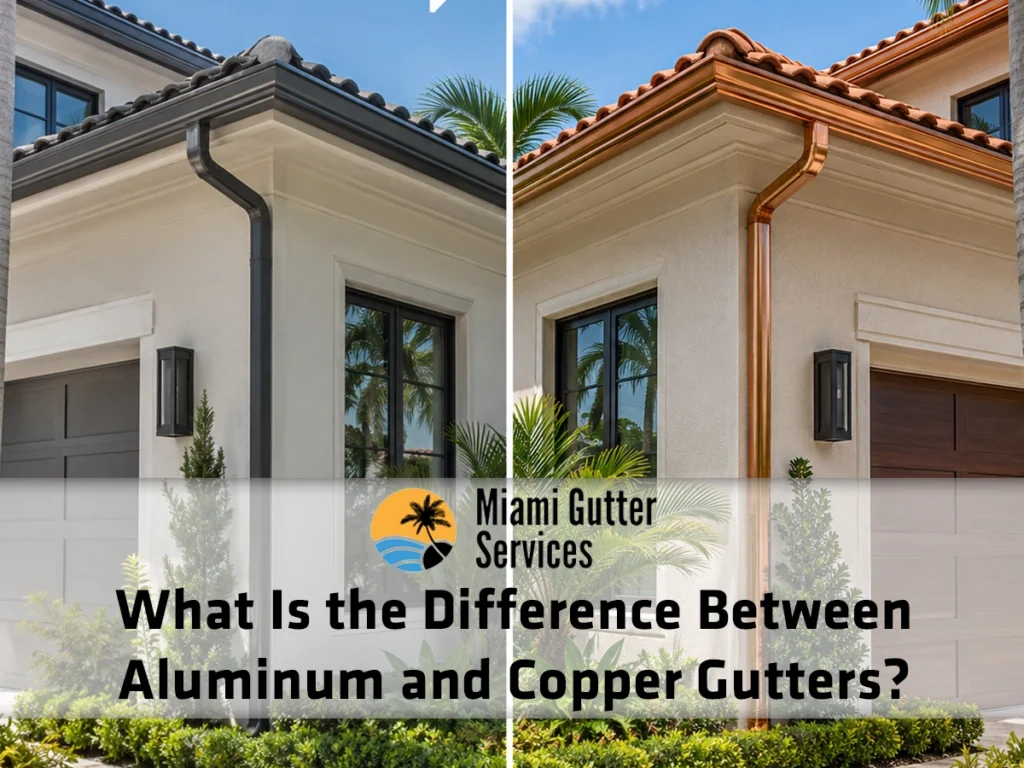
A Powerful Comparison for Miami Homeowners
Miami International Airport records a normal annual rainfall of about 67.41 inches under the current 1991 through 2020 climate normals. Therefore, gutters in Miami must do more than complement a home. They must repeatedly collect heavy roof runoff and move it toward safe drainage areas.
AI Overview
The main difference between aluminum and copper gutters involves cost, weight, appearance, installation needs, and long term value.
Aluminum is usually the more affordable option. It is lightweight, resists rust, and works well for many standard residential properties. It can also be finished in colors that blend with the roof edge, fascia, walls, or exterior trim.
Copper usually costs more because the material is more expensive and requires specialized forming, cutting, and joining skills. However, copper creates a richer appearance and can become a major design feature on luxury, historic, and custom homes. It also develops a natural patina as it ages.
Both materials still need the correct gutter size, slope, hanger support, downspout placement, cleaning, and water flow testing. Therefore, homeowners should not select a gutter based only on material.
Miami Gutter Services compares the following factors before making a recommendation:
- The homeowner’s short term budget and long term goals
- The design and value of the property
- Miami humidity, rainfall, storms, and coastal exposure
- The desired color, finish, and visual effect
- Installation complexity and required workmanship
- Ongoing cleaning and inspection needs
For most budget focused residential projects, aluminum is often the practical choice. For luxury or custom homes where the gutter should become an architectural feature, copper may offer stronger long term value.
1. What Is the Difference Between Aluminum and Copper Gutters?
Aluminum and copper gutters perform the same basic job. Both collect rainwater from the roof and guide it into downspouts.
However, the materials differ in several important ways:
- Aluminum is lighter and generally more affordable.
- Copper offers a richer appearance and higher material cost.
- Aluminum can be finished in many colors.
- Copper changes color naturally as it weathers.
- Copper installation usually requires more specialized skill.
- Aluminum is commonly used on standard residential homes.
According to the Aluminum Association, aluminum is lightweight, durable, and corrosion resistant. Aluminum exposed to air forms a protective oxide coating, and it does not rust in the same way as steel.
Copper also has strong architectural value. The Copper Development Association explains that long term outdoor exposure generally causes copper to form a naturally protective gray green patina.
Still, material alone does not determine gutter performance.
A well installed aluminum system may outperform a poorly planned copper system. Likewise, a premium copper gutter may fail to drain correctly when the size, slope, or downspout layout is wrong.
Miami Gutter Services considers the roof pitch, overhang, fascia, style, budget, and material before designing a seamless gutter system.
2. Five Clear Reasons Aluminum Gutters Are Popular
Aluminum works well for many standard residential homes in Miami.
1. Aluminum Is Lightweight
The most important difference identified by Miami Gutter Services is that aluminum is lightweight and easier to install on many homes.
Its lower weight helps installers:
- Form long seamless gutter runs on site
- Lift and position each section along the roof edge
- Reduce unnecessary weight on the fascia
- Complete many standard installations efficiently
However, lightweight does not mean that support is unimportant.
The installer must still use proper hanger spacing and suitable fasteners. Otherwise, the gutter may sag, pull away, or lose its correct drainage slope.
2. Aluminum Is Usually More Affordable
Aluminum is generally the more affordable material for homeowners focused on the initial project budget.
A lower material cost may allow the homeowner to invest in other important parts of the system, including:
- Properly sized gutters
- Additional downspouts
- Fascia repairs
- Gutter guards
- Better drainage extensions
The final cost still depends on the total gutter length, home layout, gutter size, downspout count, and extra work. Miami Gutter Services also notes that material choice, labor, fascia needs, and roof complexity affect installation pricing.
For homeowners comparing practical options, this article about cost effective gutter solutions for Florida homes provides additional guidance.
3. Aluminum Resists Rust
Aluminum does not rust like ordinary steel.
Instead, exposure to air creates a thin protective oxide layer. This characteristic helps explain why aluminum performs well in many wet and humid environments.
However, corrosion resistance does not mean that aluminum is immune to every surface problem.
Improper storage, harsh exposure, incompatible materials, or damaged finishes may still lead to staining or surface concerns.
Therefore, correct product selection and installation remain important.
4. Aluminum Offers More Color Flexibility
Aluminum can often be selected in finishes that coordinate with the home.
A homeowner may choose a color that blends with:
- Fascia and exterior trim
- Roof colors
- Stucco or siding
- Window frames
- Existing downspouts
This flexibility makes aluminum useful when the gutter should appear subtle rather than dominant.
Miami Gutter Services often recommends aluminum when matching existing trim colors is important.
5. Aluminum Fits Many Standard Homes
Aluminum is a practical option for many standard residential properties.
It often suits homeowners who want:
- Dependable roof drainage
- A controlled project budget
- A clean seamless appearance
- Several color choices
- Easier replacement of damaged sections
For these reasons, aluminum is commonly suited to budget focused projects where appearance and performance both matter.
3. Five Premium Reasons Homeowners Choose Copper
Copper serves the same drainage purpose, but it creates a very different visual result.
1. Copper Creates a Richer Appearance
The most noticeable difference for many customers is the appearance.
Copper begins with a warm metallic color. Then, its surface changes as it reacts with the outdoor environment.
The Copper Development Association explains that copper and copper alloys are widely used in architecture because of their natural range of colors.
Copper can make the gutter system a visible design feature rather than a background element.
That look often complements:
- Luxury homes
- Historic properties
- Custom residences
- Stone or brick exteriors
- Premium roofing materials
2. Copper Develops a Natural Patina
Copper changes color as it ages.
Depending on exposure and local conditions, the surface may progress through brown tones before developing a gray green or blue green patina.
That patina is not automatically a defect. It is part of the normal weathering process for exposed architectural copper.
The Copper Development Association describes this mature patina as a natural protective coating associated with older copper roofs and other exterior copper surfaces.
Homeowners should understand this color change before installation.
Anyone who wants copper to remain bright and new looking should discuss finish expectations and maintenance needs with the installer.
3. Copper Can Offer Long Term Value
Copper normally has a higher initial cost.
However, a homeowner may view that cost differently when the property is a long term investment or custom home.
Long term value may come from:
- Its distinctive architectural appearance
- Its ability to weather naturally
- Its suitability for premium homes
- Its strong material performance when correctly installed
- Its contribution to a coordinated exterior design
The Copper Development Association describes architectural copper as durable and suitable for demanding environments, including coastal locations.
Still, the exact service life of a gutter depends on design, water volume, material thickness, installation, maintenance, and site exposure.
4. Copper Suits Custom Details
Copper is often used when the project includes visible craftsmanship.
A custom design may include:
- Decorative conductor heads
- Specialty outlets
- Custom corners
- Detailed downspout transitions
- Coordinated flashing or roof features
These details require careful forming and joining.
Therefore, copper installation should be handled by a team familiar with the material.
5. Copper Becomes an Exterior Feature
Aluminum often blends into the home. Copper often stands out.
That difference makes copper useful when the owner wants the gutter system to support the property’s architectural identity.
Homeowners considering this option can review the benefits of copper gutters for coastal homes.
4. Aluminum and Copper Gutter Cost Differences
Cost is one of the largest differences between these two materials.
Aluminum Cost Factors
Aluminum is usually better suited to budget focused projects.
Its final project cost may depend on:
- Total gutter length
- Gutter width and profile
- Material thickness
- Roof height and access
- Number of corners
- Number of downspouts
- Existing gutter removal
- Fascia repairs
Because aluminum is lighter and easier to handle, labor may also be more straightforward for many standard homes.
Copper Cost Factors
Copper costs more because of both material value and installation complexity.
Copper project pricing may reflect:
- Higher raw material cost
- Specialized cutting and forming
- More detailed joining work
- Compatible hangers and fasteners
- Decorative components
- Custom corners or outlets
- Greater care during handling
- More complex architectural layouts
Therefore, copper should not be compared with aluminum only by the price per linear foot.
The complete system and required skill level matter.
Short Term Cost Versus Long Term Value
Miami Gutter Services helps homeowners compare immediate cost with long term goals.
Aluminum may provide the better value when:
- The project has a controlled budget
- The home has a standard residential design
- Matching trim colors is important
- The owner wants reliable drainage without a premium visual feature
Copper may provide stronger value when:
- The home is luxury, historic, or custom
- The gutter should remain visible
- The owner values premium materials
- The property is a long term investment
- The changing copper finish supports the design
5. Aluminum and Copper Durability Compared
Both materials can perform well when properly installed.
However, they respond differently to impact, weather, and workmanship.
Aluminum Durability
Aluminum resists rust and performs well with suitable installation.
The Aluminum Association identifies aluminum as durable, corrosion resistant, and lightweight.
However, aluminum may dent more easily from impact.
Possible causes include:
- Falling branches
- Ladder pressure
- Maintenance tools
- Severe contact during storms
- Improper handling during installation
Material thickness also matters. A stronger aluminum gutter may resist movement better than a thinner product.
Copper Durability
Copper is stronger in several practical ways, but it still needs correct support.
A copper gutter must be installed with attention to:
- Hanger spacing
- Fastener compatibility
- Expansion and contraction
- Water capacity
- Outlet placement
- Connection methods
The Copper Development Association warns that undersized copper gutters exposed to concentrated water may deteriorate before a protective patina fully develops.
Therefore, copper should not be treated as indestructible.
Correct sizing and drainage remain essential.
6. How Miami Coastal Conditions Affect Both Materials
Miami’s climate includes humidity, frequent rain, strong storms, and coastal air.
These conditions influence both material selection and installation details.
Aluminum in Humid Conditions
Aluminum resists rust and works well in humid environments.
Its natural oxide coating contributes to corrosion resistance. However, suitable finishes and proper drainage still help protect appearance.
The installer should avoid:
- Trapped standing water
- Damaged finishes
- Poorly matched fasteners
- Contact with unsuitable materials
- Debris that remains wet for long periods
Copper in Coastal Conditions
Copper naturally weathers and develops patina.
The Copper Development Association states that copper can withstand coastal and industrial conditions, while weathering forms a protective film.
However, coastal exposure does not remove the need for careful design.
The system still requires:
- Suitable thickness
- Compatible hardware
- Proper slope
- Enough drainage capacity
- Regular debris removal
Why Installation Quality Matters More Than Material Alone
Neither aluminum nor copper can correct poor system design.
Both materials may experience problems when:
- The gutter is too small
- The slope is incorrect
- Downspouts are poorly placed
- Hangers are spaced too far apart
- The fascia is damaged
- Outlets become blocked
For this reason, Miami Gutter Services uses proper support, slope, and downspout placement for either choice.
7. Installation Differences You Should Understand
Aluminum and copper require different handling during installation.
Aluminum Installation
Aluminum is lighter and easier to carry, form, and position.
A typical seamless aluminum process may include:
- Measuring the roof edge
- Forming the gutter on site
- Cutting the run to length
- Installing outlets and end caps
- Lifting the gutter into position
- Attaching hangers at proper spacing
- Setting the drainage slope
- Installing downspouts
- Testing the system with water
Its lighter weight often makes aluminum suitable for standard residential projects.
Copper Installation
Copper requires more specialized forming, cutting, and joining skills.
The installer must understand:
- Copper compatible fasteners and supports
- Proper joint preparation
- Expansion and contraction
- Custom corner fabrication
- Decorative details
- Safe handling to protect the visible surface
Copper should not be installed as though it were simply a more expensive version of aluminum.
Its material characteristics and architectural role require a more specialized process.
8. Maintenance Needs for Aluminum and Copper Gutters
Both materials require regular cleaning and downspout checks.
No gutter material eliminates maintenance.
Shared Maintenance Tasks
Both systems should be checked for:
- Leaves and roof grit
- Clogged outlets
- Blocked downspouts
- Loose hangers
- Poor gutter slope
- Standing water
- Leaking corners
- Damaged extensions
Homes near trees may need more frequent service because debris can build up quickly.
The guide to overlooked gutter maintenance tips explains how routine care can reduce preventable damage.
Aluminum Maintenance
Aluminum finishes should be checked for scratches, dents, and worn areas.
A scratched finish does not always mean the gutter has failed. However, visible damage should be reviewed before it worsens.
Copper Maintenance
Copper should be cleaned with methods suitable for the material.
Harsh products may change the surface in ways the homeowner did not expect.
In addition, the developing patina should not automatically be treated as dirt or damage.
Homeowners should discuss appearance goals before attempting to restore bright copper.
9. Which Homes Are Best for Aluminum Gutters?
Aluminum works well for many standard residential homes.
It is especially suitable when the homeowner values:
- A practical project budget
- Lightweight material
- Rust resistance
- Several finish colors
- Easier trim matching
- Seamless fabrication
- A clean but subtle appearance
A homeowner may choose aluminum when the gutter should blend with the roof edge rather than become a design feature.
Practical Project Example
Miami Gutter Services has helped a budget focused homeowner select aluminum for a standard residential property.
The choice supported the homeowner’s priorities:
- Control the initial installation cost
- Provide reliable roof drainage
- Match the home’s existing exterior
- Use a material suited to humid conditions
- Avoid paying for a premium architectural feature
This example does not mean aluminum is always the correct option. Instead, it shows how material should match the actual property and budget.
10. Which Homes Are Best for Copper Gutters?
Copper is often suited to luxury, historic, and custom homes.
It may be the better choice when the homeowner wants:
- A visible exterior feature
- A warm metallic starting color
- A naturally changing finish
- Premium architectural detail
- Custom corners or accessories
- Strong long term design value
Copper can complement homes with stone, brick, tile, slate, wood, or detailed trim.
Premium Project Example
Miami Gutter Services has also helped a luxury homeowner choose copper to create a premium exterior feature.
In that case, the decision focused on:
- The architectural style of the home
- The desired visible gutter appearance
- Long term ownership goals
- The owner’s acceptance of natural patina
- The value of specialized workmanship
For additional design information, review the benefits of installing copper gutters in Miami.
11. Seven Questions to Ask Before Choosing
Before choosing aluminum or copper, ask these questions.
1. What Is My Real Budget?
Consider both the initial project cost and future ownership goals.
Review:
- Material cost
- Installation labor
- Downspout needs
- Fascia repairs
- Maintenance expectations
2. Should the Gutter Blend In or Stand Out?
Aluminum often blends with trim colors. Copper often becomes a visible feature.
Decide whether you prefer:
- A quiet finished edge
- A premium architectural accent
3. How Long Do I Plan to Own the Home?
Long term ownership may change how you view the higher copper cost.
Consider:
- Immediate affordability
- Long term design value
4. What Does the Home Style Support?
A standard home may look complete with aluminum. A custom home may benefit from copper.
Review:
- Roof materials
- Exterior walls
- Trim details
- Existing metal features
5. Am I Comfortable With Copper Patina?
Copper will not remain bright forever without specialized treatment.
Confirm whether you appreciate:
- Brown weathering stages
- Mature gray green patina
6. Does the Installer Work With Both Materials?
A contractor offering both options can provide a more balanced comparison.
Ask about:
- Aluminum experience
- Copper forming and joining experience
7. Is the Full Drainage System Being Designed?
Material selection should follow roof and drainage planning.
Confirm:
- Gutter size
- Slope
- Hanger spacing
- Outlet count
- Downspout placement
- Final water testing
12. Why Miami Gutter Services Offers Both Options
Miami Gutter Services does not push one material for every home.
The team explains the real cost difference and matches the choice to the home style and budget.
Its approach includes:
- Reviewing Miami humidity, rainfall, and coastal exposure
- Explaining maintenance needs for both materials
- Comparing short term cost with long term value
- Planning support, slope, and downspouts for either option
- Discussing appearance before installation
- Helping the homeowner avoid paying for features they do not need
The company provides aluminum and copper gutter installation as part of its broader gutter services. Its website also reports more than 20 years of industry experience.
13. Frequently Asked Questions
What is the difference between aluminum and copper gutters?
Aluminum gutters are lighter, more affordable, and available in many finishes. Copper gutters cost more and require specialized installation, but they offer a richer architectural appearance. Copper also develops a natural patina. Both materials need correct sizing, slope, support, downspout placement, and routine cleaning.
Are aluminum gutters good for Miami homes?
Yes. Aluminum resists rust and works well for many homes in humid climates. It is lightweight and often more affordable than copper. However, the gutter still needs the correct thickness, size, slope, hangers, and downspouts. Coastal exposure and finish quality should also be considered during product selection.
Are copper gutters worth the extra cost?
Copper may be worth the added cost for luxury, historic, or custom homes where appearance and long term architectural value matter. It develops a natural patina and can become a strong design feature. However, homeowners should understand the higher material cost, specialized installation, and changing finish before choosing it.
Which gutter material costs less?
Aluminum is usually the less expensive option. It is commonly selected for standard residential and budget focused projects. Copper generally costs more because the raw material is more valuable and installation requires specialized cutting, forming, joining, and compatible components. Roof layout and downspout needs also affect the final price.
Does aluminum rust in Miami humidity?
Aluminum does not rust like ordinary steel. It forms a protective oxide coating when exposed to air. However, aluminum may still stain or experience surface problems under certain conditions. Suitable finishes, correct drainage, compatible hardware, and regular cleaning help support its performance in humid coastal environments.
Why do copper gutters change color?
Copper changes color because its surface reacts naturally with air and moisture. It may move through brown tones before forming a gray green or blue green patina. This patina is generally considered part of copper’s normal architectural weathering rather than a defect or sign that the gutter has failed.
Which material lasts longer?
Copper can offer a longer service life when it is correctly designed, installed, and maintained. However, no single life span applies to every property. Water volume, gutter size, material thickness, coastal exposure, maintenance, fasteners, and workmanship all affect durability. High quality aluminum can also provide dependable long term service.
Do copper gutters require more maintenance?
Both aluminum and copper gutters require debris removal, downspout checks, and support inspections. Copper also requires suitable cleaning methods because harsh products may alter its appearance. Homeowners should understand that natural color change is expected. Aluminum finishes should be checked for scratches, dents, and worn areas.
Can aluminum and copper gutters handle heavy rain?
Both materials can manage heavy rain when the system is correctly sized and installed. Gutter width, roof pitch, run length, slope, outlet capacity, and downspout placement matter more than material alone. An undersized or poorly sloped copper gutter can overflow just as an incorrectly designed aluminum gutter can.
How do I choose between aluminum and copper?
Choose aluminum when affordability, low weight, rust resistance, and color matching are priorities. Consider copper when the home is luxury, historic, or custom and the gutter should become a visible design feature. A professional should compare your roof, budget, exterior style, maintenance expectations, and long term ownership goals.
14. Conclusion
What is the difference between aluminum and copper gutters?
Aluminum is usually lighter, easier to install, and more affordable. It resists rust and can match many exterior color schemes.
Therefore, aluminum works well for many standard homes and budget focused projects.
Copper creates a richer and more premium appearance. It also develops a natural patina and can add lasting architectural character.
Therefore, copper often fits luxury, historic, and custom properties.
However, material choice is only one part of a successful gutter project.
Both aluminum and copper need:
- Correct gutter sizing
- Proper slope
- Strong hanger support
- Suitable fasteners
- Enough downspouts
- Safe discharge areas
- Routine cleaning
- Water flow testing
Miami Gutter Services offers both materials and explains the advantages and limits of each option.
The team considers the homeowner’s budget, home style, Miami weather exposure, desired appearance, maintenance needs, and long term goals.
That balanced approach helps homeowners choose a gutter system based on real needs rather than price or appearance alone.
15. Call Miami Gutter Services
Contact Miami Gutter Services to compare aluminum and copper gutter options for your Miami home.
Phone: 786 882 4945
Location: 1177 SW 8th St, Miami, FL 33130
Website: www.miamiguttercompany.com
Schedule an inspection to review your roof, gutter size, downspout needs, material choices, design goals, and project budget.