
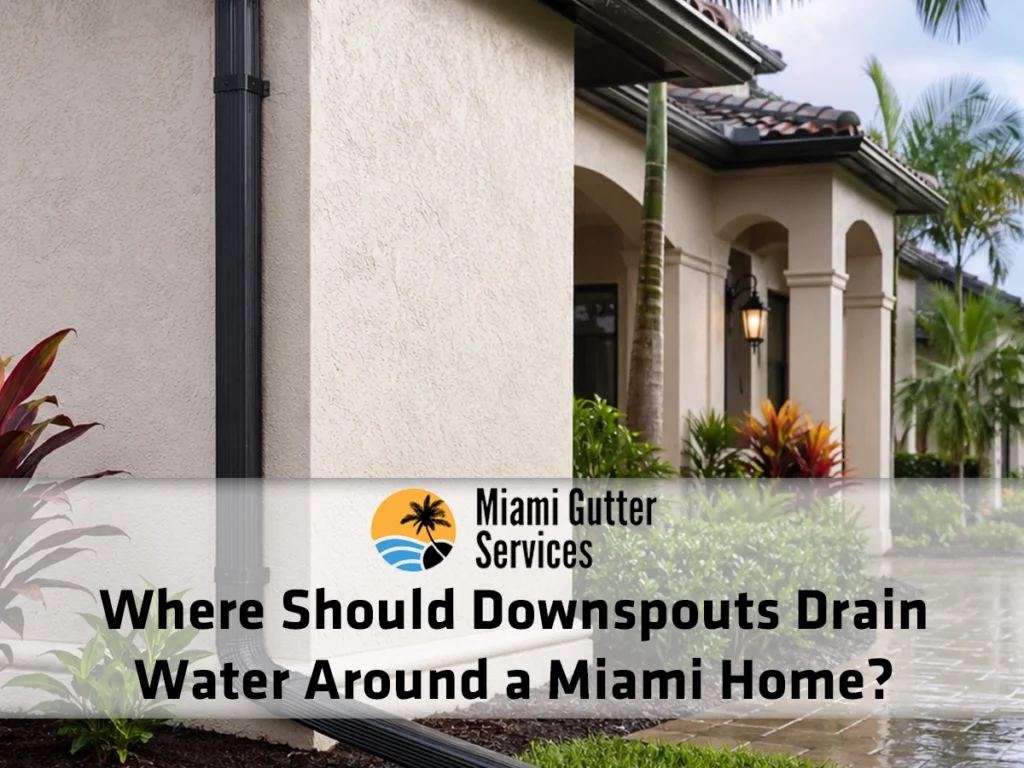
A Powerful Guide to Safe Roof Water Drainage
Miami International Airport receives about 67.41 inches of rain during a normal year. Therefore, one poorly placed downspout can release a large amount of roof water beside a home during repeated storms. National Weather Service data uses the 1991 through 2020 period for the current Miami climate normals.
AI Overview
Downspouts around a Miami home should drain toward a lower lawn or another suitable drainage area away from the foundation. They should not release water beside exterior walls, across walkways, toward garage doors, or onto neighboring property.
Miami Gutter Services generally tries to move the discharge at least three feet from the foundation when the yard slope supports safe drainage. When the property layout permits, an extension of about four to six feet may provide better separation. However, the correct distance depends on the slope, soil, landscaping, nearby structures, and final drainage area.
A longer extension does not solve the problem when it points uphill or empties into a low area. The team must first study how water moves across the yard.
The most important drainage rules include:
- Direct roof water away from the foundation.
- Follow the natural slope toward a safe lower area.
- Keep runoff away from doors, garages, patios, and walkways.
- Avoid outlets that wash away soil, mulch, or plants.
- Never redirect water onto neighboring property.
- Check extensions after major storms.
- Clear mud, leaves, and debris from every outlet.
- Reposition downspouts when the existing location causes pooling.
Miami Gutter Services checks the complete gutter and downspout system before making changes. That process helps ensure the outlet correction does not hide another problem, such as a blockage, poor gutter slope, or an undersized drainage system.
1. Where Should Downspouts Drain Water Around a Miami Home?
Downspouts should release water into a safe area that carries runoff away from the building.
In many cases, that means directing the outlet toward a lower lawn area where water can spread and soak into the ground. However, the final location must be evaluated for each property.
A suitable discharge area should meet two basic goals:
- It should move water away from the foundation.
- It should not create pooling, erosion, or a safety concern elsewhere.
The United States Environmental Protection Agency explains that redirected downspouts may release water into lawns or landscaped areas where the soil can absorb it. However, the agency also advises considering property conditions before changing the discharge route.
Miami Gutter Services reviews the natural yard slope before choosing the outlet direction. The team also looks at nearby doors, garages, patios, walkways, and low areas.
Therefore, the closest open lawn is not always the safest choice.
A lawn area may appear suitable during dry weather. Yet it can become a large puddle when the soil is already wet.
2. Seven Critical Factors That Guide Downspout Placement
A professional should consider several connected factors before moving or extending a downspout.
1. The Foundation Location
Moving water away from the foundation is the first priority.
An outlet that ends beside the wall can keep the surrounding soil wet. In addition, water may find low areas or openings near the structure.
The inspection should identify:
- How close the current outlet is to the wall
- Whether the ground slopes away from the building
- Whether water returns toward the foundation
- Whether puddles remain after rain
FEMA advises homeowners to maintain proper runoff and improve grading so stormwater drains away from buildings.
2. The Natural Yard Slope
Water follows gravity. Therefore, an extension should generally point toward a lower area.
An extension that points uphill may hold water or send it back toward the house.
Miami Gutter Services checks:
- The direction of the natural slope
- High areas that could block flow
- Low areas that already collect water
- Changes in grade near patios and walkways
A long extension that points in the wrong direction may perform worse than a shorter extension placed correctly.
3. Nearby Doors and Garages
Water should not be directed toward entrances.
Roof runoff near a door or garage may create:
- Standing water near the threshold
- Slippery walking surfaces
- Water entering through low openings
- Repeated staining near the entrance
During the inspection, the team checks how close the proposed discharge point is to doors, garage entrances, and covered access areas.
4. Walkways and Driveways
A downspout should not create a stream across a regular walking or driving path.
Water crossing concrete or pavers can create a slippery area during rain. It may also carry dirt, mulch, and leaves onto the surface.
The outlet should avoid:
- Front walkways
- Side paths
- Driveway entrances
- Patio access points
The EPA notes that downspouts directed onto paved areas send runoff quickly toward streets and drainage systems instead of allowing water to soak into suitable ground.
5. Landscaping and Loose Soil
A strong stream can wash mulch and soil away from a planting bed.
The team looks for:
- Exposed roots
- Washed mulch
- Small channels in the soil
- Displaced stones
- Mud collecting around the outlet
A splash block may help spread the flow. However, the outlet may still need to be moved when the landscaped area cannot handle the water.
6. Neighboring Property
Downspout water should remain within a suitable area on the property.
It should not be aimed toward a fence opening or property line where runoff could cross onto a neighboring lot.
The installer should consider:
- The direction of the yard slope
- Distance from the property boundary
- Existing drainage paths
- Nearby structures
- Local requirements that may affect drainage changes
7. Existing Low Areas
A low area may already collect rainwater from the yard.
Adding roof runoff can make the pooling worse.
Before choosing that location, the team should ask:
- Does water already stand there after rain?
- How quickly does the area drain?
- Will the extension increase erosion?
- Could water flow back toward the home?
3. How Far Should Downspout Water Travel?
There is no single distance that works for every Miami home.
Miami Gutter Services generally tries to move water at least three feet from the foundation when the slope supports safe drainage.
When the property layout permits, a distance of about four to six feet may provide better separation.
However, distance is only one part of the decision.
The outlet must also reach a location where water can continue moving away.
A shorter extension may work when:
- The ground slopes clearly away from the home.
- The water enters a stable lawn area.
- No walkway or door is nearby.
- The soil absorbs water without pooling.
A longer extension may be needed when:
- The yard is nearly flat.
- Water flows back toward the house.
- A lower lawn area is farther away.
- The original outlet causes repeated pooling.
- The discharge must pass a planting bed.
The best rule is to reach a suitable lower drainage area without creating another problem.
4. Five Common Downspout Drainage Problems in Miami
Miami Gutter Services commonly finds several outlet placement problems.
1. Downspouts End Too Close to the Foundation
This is one of the most frequent issues.
The vertical downspout may end only a few inches from the exterior wall. As a result, every storm releases roof water into the same small area.
Warning signs include:
- Pooling beside the wall
- Damp soil long after rain
- Mud near the outlet
- Water stains on nearby surfaces
- Erosion below the elbow
The guide to preventing water damage with downspout repair explains why outlet condition and direction matter.
2. Extensions Are Missing or Damaged
A downspout extension may become disconnected, cracked, crushed, or lost.
Without the extension, the water returns to the area beside the wall.
Inspect the system for:
- Missing pieces
- Loose connections
- Cracked plastic or metal
- Sections crushed by equipment
- Extensions moved during yard work
3. Water Drains Toward a Door or Walkway
A downspout may have been placed for convenience instead of safe drainage.
During rain, water may cross the entrance or collect near a door.
This creates two concerns:
- The area becomes difficult to use safely.
- Water may reach a low threshold or opening.
4. The Outlet Ends in a Low Yard Area
A low area may appear far enough from the foundation. However, it can still be the wrong discharge location.
Water may remain there because:
- The soil drains slowly.
- The grade traps water.
- Nearby paving blocks movement.
- Roof runoff exceeds the area’s capacity.
5. The Extension Points Uphill
Water cannot flow efficiently through an extension that rises above the outlet.
An uphill extension may:
- Hold water inside the pipe.
- Slow the downspout flow.
- Leak at the connection.
- Send water back toward the home.
- Collect mud and debris.
5. Four Clear Signs the Outlet Is in the Wrong Place
Homeowners can often identify poor drainage after a strong rain.
1. Water Pools Beside the Foundation
Pooling is one of the clearest warning signs.
Check whether the water remains near:
- Exterior walls
- Columns
- Garage edges
- Low corners
- Patio foundations
New pooling should not be ignored, even when the extension has worked before. Yard grading and soil conditions can change over time.
2. Mulch and Soil Wash Away
A concentrated stream may cut a channel through a planting bed.
Look for:
- Bare soil
- Exposed roots
- Mulch pushed into the lawn
- Mud around plants
- A deep spot below the outlet
A splash block can spread the stream. However, severe erosion may require outlet relocation.
3. Water Crosses a Walkway or Driveway
Visible water crossing a paved route means the discharge direction should be reviewed.
The flow may also carry:
- Dirt
- Leaves
- Mulch
- Roof grit
- Small stones
The outlet should be redirected toward a safe area that does not create a slippery route.
4. Puddles Form Near a Door or Garage
A puddle beside an entrance can signal poor outlet placement or a low grade.
Watch whether water:
- Moves toward the threshold
- Remains after the storm
- Spreads across the entry path
- Carries debris against the door
- Returns during every rain
6. Five Effective Ways to Correct Poor Drainage
The right solution depends on the yard and the existing gutter system.
1. Add a Longer Downspout Extension
A longer extension can move water beyond the foundation area.
It should be long enough to reach:
- A lower section of lawn
- Stable soil
- A suitable drainage area
- A location away from doors
- A point that does not affect neighbors
However, the extension must not create a trip hazard or interfere with regular property use.
2. Redirect the Extension Toward a Lower Lawn
The team may rotate or reroute the extension to follow the natural grade.
This can help water:
- Move away from the home
- Spread over a larger area
- Avoid paved surfaces
- Reduce pooling
- Soak into suitable soil
The EPA identifies lawns and landscaped areas as possible destinations for redirected downspout water when local conditions are suitable.
3. Replace a Damaged or Missing Extension
A cracked or disconnected extension cannot move water as intended.
Replacement may be needed when the section is:
- Crushed
- Split
- Missing
- Too short
- Unable to stay connected
The replacement should be secured and aimed toward the correct drainage area.
4. Add a Splash Block
A splash block helps spread the water and protect the ground below the outlet.
It may reduce:
- Soil erosion
- Mulch movement
- Mud buildup
- A deep channel below the downspout
- Water striking the foundation area
The splash block must point away from the home. It should also rest on stable ground.
5. Reposition the Downspout Outlet
Sometimes an extension cannot correct the existing location.
The outlet may need to be moved when it sits near:
- A door
- A garage entrance
- A walkway
- A low corner
- A narrow side yard
Repositioning should be planned with the gutter slope and roof drainage load in mind.
7. Why Yard Slope Matters More Than Extension Length
Homeowners often focus only on how far the extension reaches.
However, Miami Gutter Services also studies the direction of the grade.
A six foot extension can still fail when it points toward higher ground. Likewise, a three foot extension may work well when it reaches a clear downward slope.
The team evaluates:
- Where the water will travel after leaving the extension
- Whether the yard sends water back toward the home
- Whether a low spot will trap the runoff
- Whether the discharge route crosses a paved area
- Whether soil erosion will occur
FEMA advises homeowners to make sure yards slope away from buildings and that runoff has a place to drain.
Therefore, the goal is not merely to move water farther. The goal is to move water into a route that remains safe after it leaves the pipe.
8. What Homeowners Should Never Do
Several outlet mistakes can transfer water from one problem area to another.
1. Never Send Water Toward the Foundation
An extension should not point back toward the building.
Even a slight reverse slope can return water to the wall.
2. Never Point an Extension Uphill
Water may remain inside the extension or flow backward.
Instead, follow a downward route.
3. Never Drain Across a Walkway
Water crossing a walking path can create a safety concern.
It can also carry debris and dirt across the surface.
4. Never Send Runoff Onto Neighboring Property
A drainage correction should not shift the problem across a property line.
The final route should remain within an appropriate area.
5. Never Use an Existing Flooded Low Spot
A location that already floods should not receive more roof water.
Instead, identify another lower route that can manage the discharge.
6. Never Release Strong Flow Into Loose Soil
Loose soil may wash away quickly.
Use a splash block, stable surface, or another suitable erosion control method.
9. How Miami Gutter Services Inspects Downspout Drainage
Miami Gutter Services inspects the full system before making changes.
Step 1: Check the Yard Slope
The team identifies the natural high and low areas.
This helps determine:
- Where water currently travels
- Where water may become trapped
- Which routes move away from the house
- Which locations should be avoided
Step 2: Observe Existing Water Flow
When evidence is available after rain, the team checks:
- Puddles
- Mud lines
- Erosion paths
- Washed mulch
- Damp soil
These signs show how the property actually handles runoff.
Step 3: Identify Low Areas
The team marks areas where water remains.
A low area may be unsuitable even when it is several feet from the wall.
Step 4: Measure the Needed Distance
The extension should reach beyond the problem area.
The team considers:
- Foundation distance
- Yard grade
- Landscaping
- Walkways
- Nearby doors
Step 5: Inspect the Full Gutter System
The downspout outlet is only one part of the drainage path.
The team also checks:
- Gutter slope
- Downspout flow
- Outlet blockages
- Loose connections
- Gutter capacity
The article about common gutter problems and practical repairs explains how drainage issues can have several connected causes.
10. A Realistic Miami Drainage Case Example
The following examples reflect drainage problems identified by Miami Gutter Services.
At one home, a downspout ended beside the foundation and caused pooling after rain.
At another property, a missing extension allowed water to collect near an exterior wall.
Other common situations included:
- An extension pointing uphill
- Water crossing a walkway
- Roof runoff washing mulch from a landscaped bed
In each case, the visible puddle was only part of the problem.
The team needed to review where the water started, where it traveled, and where it could safely finish.
Possible corrections included:
- Adding a longer extension
- Redirecting it toward a lower lawn area
- Replacing missing parts
- Adding a splash block
- Repositioning the outlet
The final decision depended on the yard layout and drainage route.
11. Five Essential Maintenance Steps
A corrected drainage system still needs routine checks.
1. Check Extensions After Major Storms
Wind, yard work, and flowing water can move an extension.
Confirm that it remains:
- Connected
- Uncrushed
- Pointed away from the home
- Clear of branches
- Positioned on stable ground
2. Clear the Outlet
Leaves, mud, and debris can block the end of the extension.
Remove material that slows water or redirects it toward the house.
3. Confirm the Direction
An extension may shift during mowing or landscaping work.
Make sure it still points toward the intended lower area.
4. Inspect Splash Blocks
A splash block may move or sink into the soil.
Check that it:
- Points away from the foundation
- Remains level enough to carry water
- Has not become buried
- Does not create a new puddle
5. Watch for New Pooling
Drainage conditions can change.
Look for puddles that did not appear before.
FEMA recommends maintaining gutters, downspouts, and splash pads so roof runoff moves easily away from the home.
12. Why Full System Planning Produces Better Results
Moving one extension may appear simple. However, downspouts should be planned as part of the full gutter system.
The outlet location affects:
- How quickly the downspout drains
- Whether water backs up
- Where erosion occurs
- Whether the foundation remains dry
- How people move around the property
Miami Gutter Services checks the gutter and downspout system before making changes.
That process can reveal issues such as:
- A clogged downspout
- An undersized outlet
- Poor gutter slope
- A loose elbow
- Too much water reaching one downspout
A longer extension cannot repair a blockage inside the vertical pipe. Likewise, repositioning an outlet will not correct a gutter that holds standing water.
13. Why Miami Gutter Services Stands Out
Miami Gutter Services uses a property specific drainage process.
The team:
- Checks the yard slope before selecting a discharge point
- Measures how far water must travel from the foundation
- Avoids doors, garages, patios, and walkways
- Protects landscaping from erosion
- Looks for a lower drainage area
- Replaces missing or damaged extensions
- Repositions outlets that cause pooling
- Inspects the full gutter and downspout system
The company website lists downspout installation and repair among its gutter services. It also reports more than twenty years of gutter industry experience in South Florida.
This complete approach helps prevent a quick correction from creating another drainage problem nearby.
14. Frequently Asked Questions
Where should downspouts drain water around a Miami home?
Downspouts should drain toward a suitable lower lawn or drainage area away from the foundation. The outlet should not point toward exterior walls, doors, garages, walkways, or neighboring property. The safest location depends on the yard slope, soil, landscaping, property layout, and the amount of roof water.
How far should a downspout extend from the foundation?
Miami Gutter Services generally tries to move water at least three feet away when the yard slope supports drainage. Four to six feet may work better when the property allows it. However, distance alone is not enough. The extension must reach an area where water continues moving away from the home.
Can a downspout drain onto a lawn?
A lawn may be a suitable drainage area when it slopes away from the home and does not remain flooded. The water should spread without washing away soil or flowing onto a neighboring property. Avoid low lawn areas that already hold water after storms.
Why does water pool near my downspout?
Pooling may occur because the outlet ends too close to the foundation, the extension is missing, or the yard slopes toward the house. A low area may also trap runoff. The downspout and yard drainage route should be inspected before adding a longer extension.
Should a downspout drain across a walkway?
No. Water crossing a walkway may create a slippery surface and carry dirt, leaves, or mulch into the walking area. The extension should be redirected toward a suitable lawn or drainage location that does not block access to doors, garages, patios, or driveways.
Do splash blocks help downspout drainage?
A splash block can spread water and reduce erosion directly below the outlet. However, it must point away from the foundation and rest on stable ground. It will not solve poor grading, a flooded low area, or an outlet that remains too close to the building.
Why does my downspout extension point uphill?
An extension may shift during lawn care, landscaping, or a storm. It may also have been installed without checking the yard slope. An uphill extension can hold water and reduce drainage. It should be redirected toward a lower area that carries water away from the house.
Can downspout water drain onto a neighboring property?
Runoff should not be intentionally redirected onto neighboring property. The outlet should release water into a suitable area within the property while avoiding erosion, structures, and property boundaries. Local drainage rules may also affect what changes are permitted.
How often should downspout extensions be checked?
Extensions should be inspected after major storms and during regular gutter maintenance. Check for cracks, crushed sections, loose connections, mud, leaves, movement, and new pooling. Also confirm that splash blocks remain correctly positioned and that water still moves away from the foundation.
When should I call a professional about downspout drainage?
Call a professional when water repeatedly pools near the foundation, crosses a walkway, enters a garage area, or washes away landscaping. Professional help is also useful when the yard is flat, the correct drainage route is unclear, or the outlet must be repositioned.
15. Conclusion
Where should downspouts drain water around a Miami home?
They should drain toward a lower, suitable area that moves roof runoff away from the foundation.
In many cases, that means extending the outlet at least three feet from the home. When the layout allows, four to six feet may provide better separation.
However, the final direction matters more than the extension length alone.
The outlet should not:
- Point uphill
- Drain across a walkway
- Empty near a garage entrance
- Release water into a flooded low area
- Wash away landscaping
- Send runoff onto neighboring property
Miami Gutter Services checks the yard slope, observes drainage patterns, identifies low areas, measures the required distance, and inspects nearby access points.
The team can then add a longer extension, replace damaged parts, install a splash block, redirect the outlet, or reposition the downspout.
Most importantly, the team reviews the complete gutter and downspout system before recommending changes.
That full inspection helps ensure roof water reaches a safe destination instead of moving from one problem area to another.
16. Call Miami Gutter Services
Contact Miami Gutter Services for professional downspout inspection, repair, extension replacement, and drainage correction.
Phone: 786 882 4945
Location: 1177 SW 8th St, Miami, FL 33130
Website: www.miamiguttercompany.com
Schedule an inspection when water pools near your foundation, crosses a walkway, washes away landscaping, or flows back toward your home.