
12 Powerful Causes Miami Homeowners Should Never Ignore
Miami Dade County explains that the area has a high water table and limited natural drainage. Therefore, major storms can leave rainwater with few places to go, especially in low areas. That local fact makes water pooling around a home more than a minor lawn problem.
AI Overview
Water may pool around your house after rain because clogged gutters overflow, downspouts end too close to the building, or damaged downspouts release water in the wrong place.
Other possible causes include leaking gutter joints, poor gutter slope, low areas in the yard, compact soil, or ground that slopes toward the house.
Miami Gutter Services often finds that several warning signs appear together. Homeowners may see gutter overflow, standing water, washed out mulch, wall stains, soil erosion, and damaged downspouts during the same inspection.
The correct solution depends on where the water begins and where it collects. A complete inspection should follow the water from the roof, through the gutters and downspouts, to the final discharge point.
Common repairs include cleaning gutters, clearing or repairing downspouts, correcting gutter slope, sealing leaks, extending discharge farther away, and improving the ground level release area.
Water that disappears after several hours should not always be ignored. Repeated pooling can damage landscaping, erode soil, wet exterior walls, and increase moisture concerns around the foundation.
1. Why Water Pooling Around a House Matters
Gutters and downspouts form a connected drainage system. The gutters catch roof runoff, while the downspouts carry that water toward a safer release point.
When one part fails, a large amount of roof water may reach one small area beside the house.
The first signs often include:
- A puddle directly below an overflowing gutter
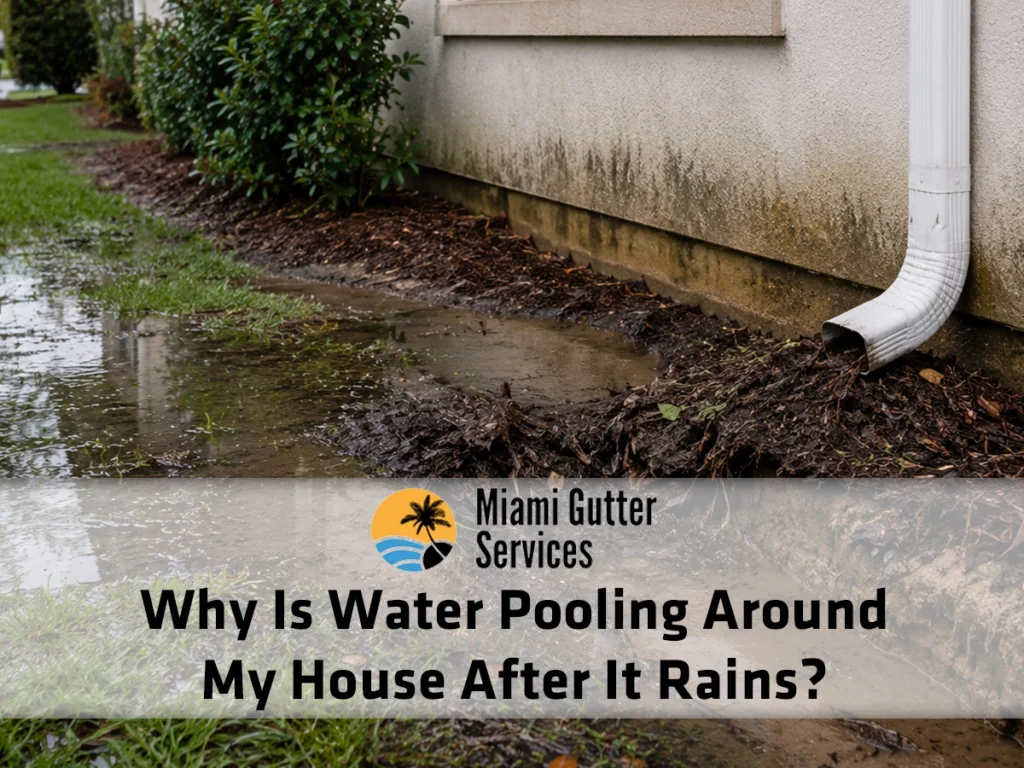
- Standing water near the end of a downspout
- Mud or damaged mulch after each storm
- Dark marks along the lower exterior wall
These signs show that water is not moving through the intended drainage path.
The water may eventually disappear through evaporation or soil absorption. However, the cause remains. Therefore, the puddle may return during every storm.
Repeated pooling can affect several areas at once:
- Soil and landscaping
- Walkways and paved surfaces
- Exterior paint, stucco, or siding
- The ground near the foundation
Miami Gutter Services checks the complete drainage path because the visible puddle may not reveal the original failure.
For example, water near a downspout could result from a short discharge point. However, it could also come from a blockage, cracked elbow, loose connection, or poor gutter slope.
2. Clogged Gutters Can Overflow Near the Foundation
Clogged gutters are one of the most common causes identified through the experience provided for this article.
Leaves, twigs, dirt, roof debris, and nesting material can prevent water from reaching the downspout. As rain continues, the gutter fills and spills over the edge.
Overflow commonly appears:
- Directly beneath the clogged section
- Near a corner or gutter joint
- Above a landscaping bed
- Beside a foundation wall
One overflowing section can send repeated sheets of water toward the same ground area.
During heavy rain, the soil may not absorb the water quickly enough. A puddle then forms beneath the gutter.
The problem can become worse when the gutter already has poor slope. Water may collect in a low section rather than moving toward the outlet.
Homeowners should look for leaves above the gutter edge, plants growing inside the channel, and water spilling from one location.
However, they should avoid unsafe ladder use during rain.
Professional cleaning should address:
- The entire gutter channel
- The gutter outlets
- The downspout openings
- Any compact material inside bends
Cleaning only the visible debris may leave a blockage deeper in the system.
3. Downspouts May End Too Close to the House
A downspout can work correctly but still create pooling when it releases water too close to the building.
The downspout gathers water from a large roof area. Therefore, its discharge point may receive a strong flow during a short storm.
Warning signs include:
- A deep puddle directly below the outlet
- Washed out soil at the downspout base
- Mulch pushed away after rain
- Water flowing back toward the wall
- A damp line along the lower exterior surface
A short splash block may not solve every situation. Its size, position, ground slope, and water volume all affect performance.
In some cases, the discharge point needs to extend farther from the foundation. However, an extension should release water where it can drain without creating a new problem for a walkway, neighbor, or lower area.
The surrounding grade also matters.
When the ground slopes toward the house, water may travel back after leaving the downspout. Therefore, extending the outlet alone may not correct the full problem.
Miami Gutter Services evaluates both the downspout and the ground where it releases water.
This approach helps determine whether the home needs:
- A longer downspout extension
- A corrected outlet direction
- A better discharge surface
- Additional ground drainage evaluation
4. Blocked or Damaged Downspouts Can Release Water Incorrectly
Blocked or damaged downspouts are another common cause identified by Miami Gutter Services.
A downspout may appear open at the bottom while debris remains trapped inside an upper elbow.
Possible blockage points include:
- The gutter outlet
- The first downspout elbow
- A narrow vertical section
- A lower elbow near the ground
- A connection to another drainage component
When the downspout is blocked, water may rise inside the gutter and spill over the edge.
A cracked or disconnected section creates a different problem. Water may escape halfway down the wall instead of reaching the intended outlet.
Visible signs include:
- Leaking joints
- Loose elbows
- Cracks or holes
- Water spraying from a connection
- Little water leaving the lower outlet
Several warning signs may appear together. For example, the homeowner may notice overflow above, a wet wall, eroded soil, and a puddle near the foundation.
Miami Gutter Services recommends checking the complete downspout rather than treating only the lowest visible section.
Homeowners can learn more about how downspout repair helps prevent water damage.
5. Poor Gutter Slope Can Send Water to the Wrong Area
Gutters need a controlled slope toward their outlets.
When the slope is incorrect, water may remain in the channel or move toward the wrong end.
Possible signs include:
- Standing water inside the gutter after rain
- Overflow from the middle of a gutter run
- Water collecting away from the downspout
- Sagging sections between hangers
- Debris gathering repeatedly in one location
Poor slope may result from installation issues, loose fasteners, damaged fascia, storm movement, or the weight of wet debris.
Correcting slope requires more than pushing the gutter upward.
The technician should inspect:
- Hanger position
- Gutter shape
- Fastener condition
- Fascia strength
- Outlet location
- Downspout capacity
When the support remains sound, the gutter may be realigned.
However, a bent or heavily damaged section may need replacement.
Miami Gutter Services states that roof pitch, overhang, fascia, and property needs should be considered when planning gutter installation or replacement.
6. Leaking Seams and Corners Can Create Hidden Puddles
Water does not always reach the ground through an obvious overflow.
A seam, corner, end cap, or outlet may release a smaller stream during each storm.
These leaks commonly occur near:
- Inside corners
- Outside corners
- Gutter section joints
- End caps
- Downspout outlets
- Loose fasteners
A slow leak may create a wet patch rather than a large puddle.
Because the area dries later, homeowners may assume it is harmless. However, repeated moisture can wash away soil, stain walls, and keep nearby materials damp.
A useful inspection should identify whether the joint has:
- Failed sealant
- Physical damage
- Corrosion
- Poor alignment
- Pressure from standing water
Adding sealant over dirt or wet material may not provide a lasting repair.
First, the area should be cleaned and assessed. Then, the cause should be corrected.
Homeowners can review common gutter problems and practical repairs for more information.
7. Low Areas in the Yard Can Trap Roof Runoff
Not every puddle begins with a failed gutter.
Some properties have low areas that collect both roof runoff and normal rainfall.
A low area may develop because of:
- Natural ground shape
- Soil settlement
- Repeated erosion
- Landscaping changes
- Walkway or driveway placement
- Poor surface drainage
Miami Dade County states that the region lies close to sea level and has an underground water supply near the ground surface. Major rain events can leave water with limited places to drain.
Therefore, gutter repairs may reduce the amount of water entering the area without eliminating a larger site drainage issue.
The inspection should determine:
- Whether roof water is feeding the puddle
- Whether the downspout releases into the low area
- Whether the ground slopes toward the house
- Whether water remains long after the storm
When the issue involves broad property grading or drainage design, the homeowner may need help from a qualified drainage, landscaping, or engineering professional.
Miami Gutter Services focuses on the gutter and downspout system while identifying when the problem extends beyond that scope.
8. Poor Soil Drainage Can Slow Water Absorption
Soil conditions affect how quickly rainwater leaves the surface.
Compacted soil may absorb water slowly. Saturated soil may also stop accepting additional rainfall.
Signs of poor soil drainage include:
- Water remaining long after the rain ends
- Soft ground around the puddle
- Repeated mud in the same area
- Plant decline from excess moisture
- Surface water spreading beyond the outlet
The gutter system may still contribute to the problem because it concentrates roof runoff.
For example, a downspout may release water correctly but place too much flow onto a small compact area.
In that case, the solution may require several changes:
- Extend the discharge point
- Spread water across a safer area
- Improve the outlet surface
- Address the surrounding ground condition
Miami Gutter Services uses several repair options rather than one standard solution.
That approach is important because clearing a gutter cannot correct every soil problem. Likewise, changing the soil alone will not fix a clogged downspout.
9. Ground That Slopes Toward the House Can Bring Water Back
The ground around a home should not direct surface water toward the building.
When the grade slopes inward, rainwater and downspout discharge may move toward the foundation.
Warning signs include:
- Water collecting along the wall
- A wet strip around the home
- Mulch moving toward the foundation
- Soil settlement near the building
- Puddles that touch the exterior wall
Adding soil without checking the gutter system is a common mistake.
The homeowner may raise one area while leaving a clogged gutter or short downspout unchanged. As a result, water may find another low route.
The full inspection should begin at the roofline and end at the final ground discharge point.
Important questions include:
- Where does the water leave the roof?
- Does the gutter carry it to the outlet?
- Does the downspout remain clear?
- Where does the water travel after discharge?
- Does the ground move it away or back toward the home?
This process helps separate gutter problems from broader grading concerns.
10. Soil Erosion Can Make Pooling Worse Over Time
Pooling water can remove soil from the same area during each storm.
At first, the homeowner may notice displaced mulch. Later, the area may become a deeper depression that holds even more water.
This creates a repeating cycle:
- Roof runoff reaches one location
- The water removes loose soil
- A lower area develops
- Future water collects in that depression
- Additional erosion makes the area deeper
Signs of erosion include:
- Exposed roots
- Channels in soil
- Missing mulch
- Soil collecting on walkways
- Gaps beneath splash blocks
- A deeper hole below the downspout
Correcting the gutter or downspout source helps stop additional concentrated flow.
However, the damaged ground may also need restoration.
Miami Gutter Services looks for erosion, wall stains, and foundation moisture during its drainage assessment.
The goal is not only to remove the visible puddle. It is to correct the path that repeatedly sends water to that area.
11. Repeated Moisture Can Affect Exterior Materials
Pooling water may splash against stucco, paint, siding, doors, and trim.
Repeated wetting can leave stains and support organic growth on suitable surfaces.
Look for:
- Dark marks near the ground
- Peeling exterior paint
- Green or black surface growth
- Damp areas near door frames
- Discoloration around cracks
A stain does not prove that serious hidden damage exists. However, it shows that water has repeatedly reached that location.
The United States Environmental Protection Agency explains that moisture control is the key to mold control. It also recommends fixing the water problem when mold or repeated dampness is present.
Therefore, cleaning or painting the surface without correcting the drainage source may provide only a temporary improvement.
The safer sequence is:
- Identify the source
- Stop repeated water contact
- Allow affected areas to dry
- Repair damaged finishes or materials
12. Pooling May Be Part of a Larger Flooding Problem
Some water problems begin beyond the gutter system.
Street flooding, overwhelmed storm drains, high groundwater, and broad low areas can affect entire properties.
The City of Miami provides a system for residents to report street flooding, storm drain concerns, and other local flooding problems.
The South Florida Water Management District also explains that flood control is a shared responsibility involving regional systems, local governments, drainage districts, associations, and residents.
A gutter contractor can diagnose roof drainage problems. However, the contractor cannot control public drainage systems or regional groundwater.
Possible signs of a larger issue include:
- Water entering from the street
- Several neighboring properties flooding
- Water rising from broad low areas
- Storm drains backing up
- Pooling far from any downspout
When those signs appear, homeowners should use local flood resources and consider additional professional guidance.
FEMA also maintains the official public source for federal flood hazard information and flood maps.
13. How Quickly Can Pooling Water Cause Damage?
The experience provided by Miami Gutter Services indicates that damage can begin after one heavy rain.
It may become worse during repeated storms, especially where soil drainage is already poor.
The speed depends on several factors:
- Rainfall amount
- Gutter condition
- Downspout condition
- Ground slope
- Soil absorption
- Existing erosion
- Distance from the foundation
One storm may wash out mulch or create a shallow puddle.
Repeated storms may deepen the low area, stain the wall, loosen soil, or keep exterior surfaces damp.
Miami Dade County identifies May 15 through October 15 as the local rainy season. During this period, repeated rainfall can reduce the time available for saturated areas to dry.
Therefore, homeowners should not wait for a fixed number of storms.
The correct time to act is when water repeatedly collects in the same location.
14. What Miami Gutter Services Checks First
Miami Gutter Services follows the water from the roofline to the ground.
The inspection covers:
- Gutter clogs and overflow points
- Downspout blockages or damage
- Downspout discharge locations
- Gutter slope and water flow
- Leaking seams, corners, and end caps
- Soil slope near the home
- Low areas where water collects
This complete approach prevents a common mistake: repairing only the visible puddle.
For example, adding soil may hide a low area. However, it will not clear a blocked downspout.
Likewise, extending a downspout may not solve an overflowing gutter caused by debris.
Miami Gutter Services also looks for:
- Soil erosion
- Exterior wall stains
- Foundation moisture
- Damaged landscaping
- Disconnected drainage parts
The team then explains the likely cause before recommending repair.
15. Which Repairs Can Stop Water Pooling?
There is no single repair for every pooling problem.
The correct solution depends on the inspection findings.
Possible repairs include:
- Cleaning clogged gutters
- Clearing downspout outlets
- Repairing damaged downspouts
- Extending discharge farther away
- Correcting gutter slope
- Sealing leaking seams
- Replacing damaged gutter sections
- Improving the ground discharge area
Several repairs may be required at the same property.
For example, a home may have a clogged gutter, a loose downspout elbow, and an outlet that ends beside the wall.
Cleaning alone would improve flow. However, the damaged connection and poor discharge point would remain.
Miami Gutter Services recommends repair before replacement when practical.
Replacement may become appropriate when the gutter is badly bent, detached, corroded, or unable to drain reliably.
Review why timely gutter repairs protect Miami homes before several small issues become one larger drainage failure.
16. Why Homeowners Often Treat the Wrong Problem
Pooling water is easy to see. The original cause may be much harder to find.
Common mistakes include:
- Waiting because the puddle eventually dries
- Adding soil before checking the gutters
- Using a short splash block for a large flow
- Cleaning one gutter section only
- Ignoring the downspout interior
- Sealing cracks without correcting drainage
- Waiting for another storm
- Attempting unsafe ladder work
These actions often treat the symptom instead of the source.
A puddle can disappear while the gutter remains blocked.
Likewise, new mulch can cover erosion without stopping the flow that caused it.
The better approach is to answer two questions:
- Where does the water begin?
- Where should it safely end?
Those questions guide the complete repair.
17. How to Check the Problem Safely After Rain
Homeowners can collect useful information without climbing onto the roof.
After rain, safely walk around the property and observe:
- Which gutter sections overflowed
- Where each downspout released water
- How close puddles are to the house
- Whether soil or mulch moved
- Whether the wall shows fresh stains
- How long standing water remains
Photographs can help document the pattern.
During the next dry period, look for loose joints, visible debris, damaged outlets, and downspout separation from ground level.
Do not:
- Climb during rain
- Lean a ladder against a loose gutter
- Reach into unseen debris
- Walk on a wet roof
- Pull on damaged downspouts
When safe access is uncertain, schedule a professional inspection.
18. How Miami Homeowners Can Reduce Future Pooling
Routine maintenance helps catch drainage problems before they become larger.
Useful steps include:
- Keep gutters and outlets clear
- Check downspouts after strong storms
- Watch for erosion below discharge points
- Repair leaks before the rainy season
- Confirm that outlets direct water away
- Inspect low areas after heavy rain
Miami Gutter Services provides gutter installation, repair, cleaning, downspout, seamless gutter, and gutter guard services. Its website states that the company has more than 20 years of gutter service experience.
Homeowners can also review these gutter preparation steps before hurricane season.
Frequently Asked Questions
1. Why is water pooling around my house after it rains?
Water may pool because gutters are clogged, downspouts are blocked, or outlets end too close to the house. Poor ground slope, compact soil, and low yard areas may also contribute. A complete inspection should follow the water from the roof to the final discharge point.
2. Can clogged gutters cause water near my foundation?
Yes. A clogged gutter may overflow directly beside the house instead of carrying water to a downspout. Repeated overflow can saturate soil, wash away mulch, stain exterior walls, and create puddles near the foundation. Cleaning should include the gutter outlets and downspouts.
3. Why does water collect below my downspout?
The downspout may end too close to the house, release water into a low area, or discharge onto soil that absorbs water slowly. The downspout could also be damaged or partly blocked. Its full length and final release point should be inspected.
4. Will adding soil stop water from pooling?
Adding soil may help when the ground slope is the main cause. However, it will not correct clogged gutters, blocked downspouts, leaking seams, or damaged outlets. The gutter and downspout system should be inspected before the ground is changed.
5. How far should a downspout release water from the house?
The correct distance depends on the property slope, soil, water volume, discharge area, and local conditions. The main goal is to release water where it continues moving away from the building without creating erosion, walkway hazards, or drainage problems elsewhere.
6. Can standing water damage my foundation?
Repeated water near a foundation can saturate surrounding soil and contribute to moisture concerns. However, the exact risk depends on the building, soil, drainage, and existing conditions. Homeowners should correct concentrated roof runoff and consult the proper specialist when structural concerns appear.
7. How do I know if a downspout is blocked?
Common signs include gutter overflow, little water leaving the bottom outlet, leaking joints, standing water inside the gutter, and debris near the outlet. A blockage may remain hidden inside an elbow, so checking only the open bottom is not always enough.
8. Should I wait to see whether pooling returns?
Waiting through additional storms may allow erosion, stains, soil saturation, and other damage to become worse. Document where the water begins and collects, then inspect the full drainage path. Early repair is usually simpler than correcting several connected problems later.
9. Can gutter repair stop water pooling around my home?
Gutter repair can stop pooling when the cause is a clog, leak, poor slope, damaged section, or blocked downspout. However, low ground, compact soil, or broader flooding may require additional solutions. The repair should match the actual source found during inspection.
10. What should a drainage inspection include?
The inspection should cover gutters, outlets, downspouts, seams, corners, slope, discharge points, surrounding soil, erosion, wall stains, and low areas. Following water from the roof to the ground helps identify connected problems and prevents incomplete repairs.
Conclusion
Why is water pooling around my house after it rains?
The most common gutter related causes are clogged gutters, blocked or damaged downspouts, and outlets that end too close to the home.
However, the puddle may involve several connected issues.
Poor gutter slope, leaking seams, low ground, soil erosion, compact soil, and broad local drainage conditions may also play a role.
Therefore, the solution should not focus only on the visible standing water.
Miami Gutter Services recommends following the complete path from the roofline to the ground. That means checking the gutters, outlets, downspouts, seams, discharge areas, soil slope, and low spots together.
Cleaning may solve one part of the problem. Yet some properties also need downspout repair, slope correction, leak sealing, discharge extensions, or damaged gutter replacement.
Most importantly, do not wait through repeated storms.
Water that dries later can still return and deepen the same drainage problem.
Early inspection helps protect landscaping, exterior surfaces, soil, walkways, and the area around the foundation.
Schedule a Complete Drainage Inspection
Miami Gutter Services can inspect where the water begins, how it moves through the gutter system, and where it collects around your property.
The team will explain the cause and recommend repair before replacement whenever practical.
Contact us at
Phone: 786 882 4945
Location: 1177 SW 8th St, Miami, FL 33130
Website: www.miamiguttercompany.com